

- Introduction
- Why the decision is called an interim decision
- The case before the Board
- Conscription alone was never a basis for asylum
- The A-G- exceptions and what R-A-N- actually changed
- What the Board left untouched
- The consequences for Russian mobilization claims
- Building the record: evidence and experts
- The circuit courts and the limits of R-A-N-
- Matter of Salim and foreign-controlled armies
- Protection under the Convention Against Torture
- Conclusion
Introduction
On July 7, 2026, the Board of Immigration Appeals published its precedential decision in Matter of R-A-N-, 29 I. & N. Dec. 739 (B.I.A. 2026).1 The Board vacated a grant of asylum to a citizen of Russia who fled his country in October 2022, when Russia intensified its mobilization of men for the war against Ukraine. The Immigration Judge had found that the applicant established no nexus between the harm he feared and any protected ground, yet granted asylum on the theory that conscription into an internationally condemned military is itself persecution. The Board rejected that theory in terms that reach every similar claim now pending in the immigration courts.
The decision announces three holdings. First, conscription does not serve as a standalone basis for asylum in the absence of a nexus to a protected ground. Second, conscription that would require an alien to engage in inhuman conduct condemned by the international community constitutes persecution only when the conscription or the required conduct is tethered to a protected ground, a holding the Board framed as a clarification of its 1987 precedent in Matter of A-G-. Third, international condemnation of the Russian military’s actions is insufficient, by itself, to render conscription persecutory; the applicant must demonstrate that, if conscripted, he himself would necessarily be required to engage in inhuman conduct on account of a protected ground.2
Our office has represented many Russian citizens who fear mobilization into the war against Ukraine, and we surveyed the case law governing these claims in our earlier article on asylum for refusal to serve in an internationally condemned military.3 That survey must now be read together with Matter of R-A-N-.
Why the decision is called an interim decision
The decision is stamped “Interim Decision #4215.” The label sometimes causes confusion, so a brief explanation is in order. The word “interim” does not mean that the ruling is temporary, provisional, or awaiting confirmation. Every precedential decision of the Board receives an interim decision number when it is first released as a slip opinion. The number identifies the decision during the period before it is compiled into a bound volume of Administrative Decisions Under Immigration and Nationality Laws of the United States, the official reports cited as I&N Decisions. The “interim” designation therefore refers to the format of publication, not to the force of the ruling. Matter of R-A-N- is binding on immigration judges and on the Department of Homeland Security nationwide from the day it issued, and it will remain binding unless a Federal court of appeals rejects it within a particular circuit, the Attorney General refers it for review, or the Board itself revisits it.4
The case before the Board
The respondent left Russia for Turkey in October 2022, when mobilization and conscription orders intensified. In March 2023, two men in government uniforms came to his registered address in Russia and asked his mother where he was. The same men returned a week later and stated that he was subject to military service and required a medical examination in order to be deployed. City administrators visited the mother again in October 2023, and in September 2024 military personnel served her with a summons directing the respondent to appear for a medical examination for purposes of military deployment.5
The Immigration Judge found that the respondent had not suffered past persecution and that his fear of future persecution on account of his political opinion, while subjectively real, was not objectively reasonable. The Immigration Judge expressly found no nexus between the feared harm and any protected ground. She nevertheless granted asylum, reasoning that the Russian military is internationally condemned and that there was at least a ten percent likelihood the respondent would be conscripted into it. On that view, conscription into a condemned military was persecution without more.
The Department of Homeland Security appealed. The Board received supplemental briefing from the parties and from amici curiae and heard oral argument on February 10, 2026. The Board sustained the appeal, vacated the grant of asylum, and remanded solely for adjudication of the respondent’s claim under the Convention Against Torture.5
Conscription alone was never a basis for asylum
The first holding breaks no new ground. To be eligible for asylum, an applicant must qualify as a refugee, which requires persecution or a well-founded fear of persecution “on account of” race, religion, nationality, membership in a particular social group, or political opinion.6 The Supreme Court held more than three decades ago that the statute “makes motive critical” and that the applicant must present direct or circumstantial evidence that the persecutor is motivated by the applicant’s actual or imputed protected characteristic.7
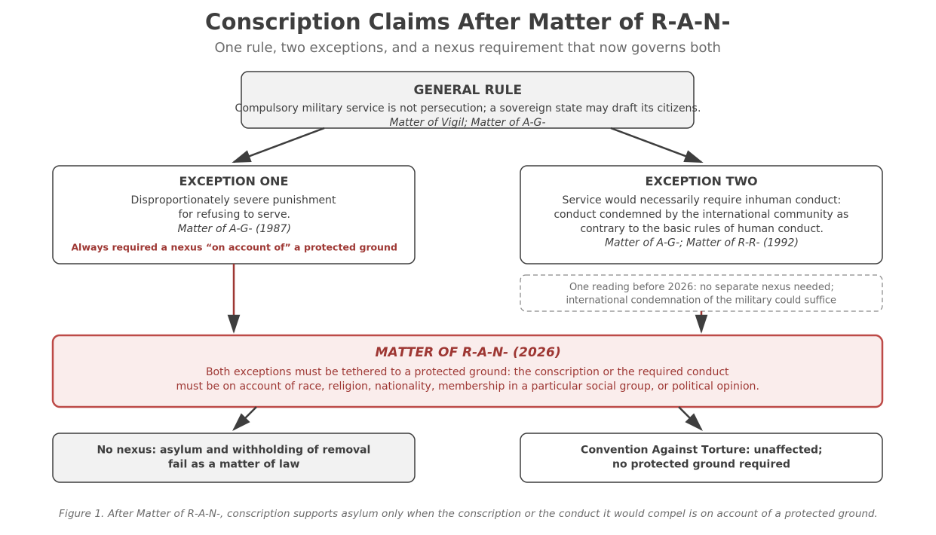
The Board’s own precedents have long said the same about military service in particular. “It is a long-established principle of international law that a sovereign government has the right to draft its citizens and maintain an army for the purpose of self-defense.”8 In Matter of A-G-, the Board held “to the long-accepted position that it is not persecution for a country to require military service of its citizens.”9
The A-G- exceptions and what R-A-N- actually changed
Matter of A-G- recognized two exceptions to the rule that compulsory military service is not persecution: cases “where a disproportionately severe punishment would result on account of” a protected ground, and cases “where the alien would necessarily be required to engage in inhuman conduct as a result of military service required by the government.”9 Five years later, in Matter of R-R-, the Board restated the second exception and defined “inhuman conduct” as “conduct condemned by the international community as contrary to the basic rules of human conduct.”10
The severe punishment exception contains express “on account of” language. The inhuman conduct exception does not. Under one reading of Matter of A-G-, that textual difference meant that the inhuman conduct exception stood on its own: forcing a person into service that would require him to commit internationally condemned acts was persecution regardless of why the state selected him for service. In practice, however, many such claims were denied for lack of a nexus to a specific protected ground, and the Board in R-A-N- pointed to its own precedents as supporting the need for one.11
The Board acknowledged that the wording of Matter of A-G- “could be read to require a nexus only as to the severe punishment exception,” and it clarified that the inhuman conduct exception must also be tethered to a covered ground, because conscription alone is not persecution and without a covered ground an applicant does not meet the refugee definition at all.11 Before R-A-N-, a Russian applicant could build a claim on proof that the Russian military is internationally condemned for inhuman conduct, that he faced a sufficient likelihood of being mobilized and forced to participate in that conduct, and that he would face persecutory harm for refusing. After R-A-N-, the same applicant must additionally prove that the conscription itself, or the conduct he would be required to perform, would be visited upon him on account of his race, religion, nationality, membership in a particular social group, or political opinion.
The third holding applies the same logic to the evidence. International condemnation of the Russian military, standing alone, does not render conscription persecutory. The applicant must show that he himself “would necessarily be required to engage in inhuman conduct” on account of a protected ground.12 The Board also addressed the shorthand phrase “internationally condemned military,” which appears in decisions such as Mohammed v. United States Attorney General. That phrase, the Board explained, is a commonly used simplification. The full standard, drawn from Mekhoukh v. Ashcroft, asks whether the applicant “would be drafted, assigned to combat duty, and become obligated to commit human rights violations.”13
What the Board left untouched
Matter of R-A-N- did not disturb the definition of inhuman conduct announced in Matter of R-R-: conduct condemned by the international community as contrary to the basic rules of human conduct.10 It did not eliminate either A-G- exception; it conditioned them. The severe punishment exception always carried a nexus requirement, and claims built on disproportionately harsh treatment of evaders on account of a protected characteristic remain viable. Claims in which conscription is itself the instrument of persecution against a protected group also remain viable. The decision likewise leaves protection under the Convention Against Torture unaffected, a point developed below.
The consequences for Russian mobilization claims
After R-A-N-, a claim that rests on nothing more than the facts that the applicant is a Russian man of serviceable age and that the Russian military stands condemned for its conduct in Ukraine fails as a matter of law before the immigration courts. The missing nexus defeats not only asylum but also withholding of removal under the Act, which turns on the same five protected grounds.14
A well-prepared Russian claim, however, was rarely built that way. These cases were demanding before the Board spoke, and not all of them succeeded. Where the evidence allows, the claim should show that the applicant would be singled out for mobilization, for the worst assignments, or for punishment on account of a protected characteristic. Russia has disproportionately mobilized ethnic and regional minorities, and it has used conscription and mobilization as a tool against perceived opponents of the war. An applicant with a record of anti-war expression, an applicant summoned shortly after police questioned him about that expression, an applicant from an ethnic minority community that bears a disproportionate share of mobilization, or a religious objector denied an exemption available to others can still connect the feared conscription to a protected ground. A summons issued in close proximity to an encounter with the authorities over the applicant’s political expression is precisely the kind of circumstantial evidence of motive that Elias-Zacarias contemplates.7 The nature of the characteristic matters. A man sought because of his military specialty or his prior service has not shown a nexus. A man sought because of his ethnicity, his religion, or his actual or imputed political opinion has.
Building the record: evidence and experts
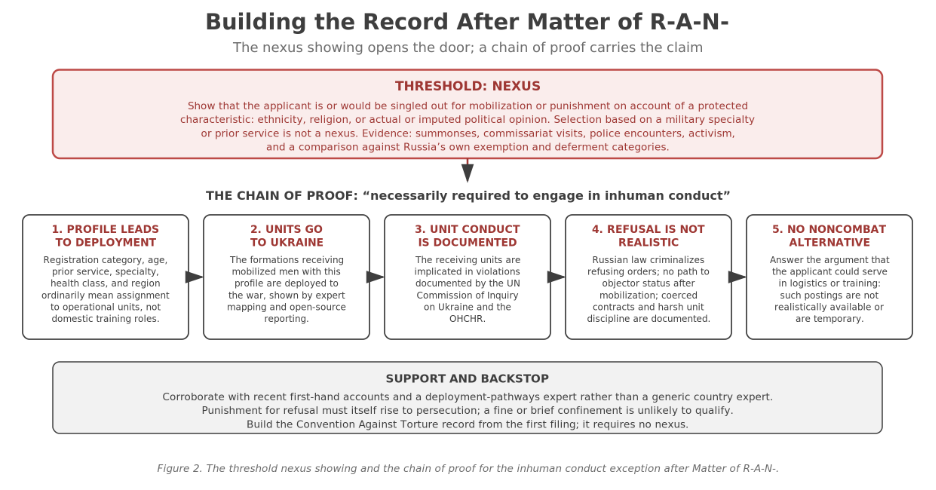
After R-A-N-, the threshold task is nexus. The record must prove the Russian government’s motive for seeking this applicant, not only the international community’s condemnation of the Russian military. The documentary core of a mobilization case remains what it was:
- military summonses and mobilization orders;
- records of visits by the military commissariat or the police;
- criminal or administrative case records;
- evidence of the applicant’s activism, public statements, or online expression;
- evidence of ethnicity, religion, or community membership.
Each item should be presented to show why this applicant, as opposed to any other man of serviceable age, has been or would be sought, and that the reason is a protected characteristic. Where the applicant holds an actual summons, it is often instructive to compare his profile against Russia’s own exemption and deferment categories. If he should not have been subject to mobilization absent the protected characteristic, the summons itself becomes circumstantial evidence of motive. An applicant who has never been summoned faces a harder road: his claim will usually depend on showing why he would be sought in the future, with reference to how Russia actually enforces mobilization against people in his position.
Once nexus is established, the record must still carry the element preserved from A-G- and R-R-: that the applicant would necessarily be required to engage in inhuman conduct if conscripted. Adjudicators rarely accept categorical predictions, so the goal is a chain of proof rather than a single assertion:
- that mobilization of a man with the applicant’s profile, considering his military registration category, age, prior service, specialty, health classification, and region, ordinarily results in assignment to operational units rather than to domestic training or support roles;
- that the units receiving such personnel are deployed to the war in Ukraine;
- that those units have been implicated in conduct documented as violations of international humanitarian law, including in the reports of the United Nations Independent International Commission of Inquiry on Ukraine and the Office of the U.N. High Commissioner for Human Rights;
- that refusal is not a realistic option, because Russian law criminalizes the refusal of orders, no meaningful path to conscientious objector status exists after mobilization, and coerced contract signing and harsh disciplinary practices within deployed units are documented;
- that there is no meaningful path to a noncombat assignment, because the government will argue that the applicant could serve in logistics, in training, or in an administrative role, and the record should explain why such alternatives are not realistically available to someone in his position or are only temporary before reassignment.
Recent first-hand accounts round out the chain. Declarations from recently mobilized soldiers, deserters, military lawyers, and Russian human rights organizations that assist servicemembers can show what has actually happened to men with comparable backgrounds.
Expert evidence grows in importance, and the most useful expert is one who can speak to deployment pathways rather than to country conditions in general. A conclusory opinion that everyone drafted into the Russian military commits war crimes will not persuade. An opinion grounded in Russian force-generation practices, tied to the applicant’s specific reserve category, specialty, and region, and connected to the documented conduct of the receiving formations addresses exactly what R-A-N- requires. Even the best expert report, though, is necessary in most cases and sufficient in none. The expert supplies the framework; the applicant’s own testimony and documents must place him inside it, and the nexus showing remains the applicant’s to make.
Imputed political opinion deserves particular care. Russian officials have publicly branded draft evaders and deserters as traitors, and Russia prosecutes public opposition to the war under laws against discrediting the armed forces. Evidence of this kind can support the argument that punishment for evasion would be motivated by a political opinion the state imputes to the evader, and not by neutral law enforcement. The Board, however, pointedly observed that draft evasion, particularly in wartime, “is punished harshly by many countries, including the United States.”15 The observation is a warning in two respects. A generic argument that evaders are punished will not do; the applicant needs country-specific evidence that Russian punishment is calibrated to perceived disloyalty and applicant-specific evidence that the authorities would view him that way. The punishment itself must also rise to the level of persecution. There are reports of Russian servicemen litigating aspects of their compulsory service, and a fine or a short term of confinement, without more, is unlikely to qualify. The record should show what actually happens to men in the applicant’s position who refuse. Finally, the theoretical availability of alternative civilian service matters in one specific way: if Russia grants alternative service to some but would deny it to the applicant because of a protected characteristic, the denial itself supports the claim.
The circuit courts and the limits of R-A-N-
A precedential Board decision binds immigration judges nationwide. It does not bind the Federal courts of appeals, each of which reviews removal cases arising within its own jurisdiction, although in practice most Board precedents are never rejected by those courts. The courts of appeals read the refugee definition for themselves, and the strength of the available arguments differs from circuit to circuit.
The most significant open question involves the Second and Seventh Circuits, the Federal appellate courts whose decisions control immigration cases arising in New York, Connecticut, and Vermont, and in Illinois, Indiana, and Wisconsin, respectively. The Second Circuit’s decision in Islami v. Gonzales recognized that an applicant may be eligible for asylum where he flees to avoid punishment for refusing to join a military force condemned by the international community, and it did so without relying on Matter of A-G-; the court drew on the UNHCR Handbook and on its own reading of the statute.16 Several of the Seventh Circuit’s decisions, including Vujisic v. INS and Mojsilovic v. INS, likewise rest on the Handbook rather than on the Board’s framework.17 Because these courts did not rely on A-G-, there is a question to what extent they will treat the Board’s clarification of A-G- as decisive, and a substantial argument that their own precedents continue to govern cases arising within those circuits. We discuss all of these decisions in detail in our earlier article.3
In other circuits the practical change is smaller. The Fourth Circuit already required a nexus in Lopez Ordonez v. Barr, a decision the Board itself cited with approval, and the Fourth Circuit’s en banc decision in M.A. v. INS remains the most detailed discussion of the kinds of official sources that can establish international condemnation.18 For the approaches taken in the First, Third, Fifth, Ninth, and Eleventh Circuits, we again direct readers to our earlier article.3
None of these arguments will help unless they are preserved. A court of appeals generally may consider only issues that were first presented to the Immigration Judge and to the Board.19 An applicant who relies on a decision such as Islami should therefore raise it at every stage of the case, and applicants whose cases were decided under the earlier understanding of A-G- should consider timely motions to reconsider.
Matter of Salim and foreign-controlled armies
In Matter of Salim, decided in 1982, the Board withheld the deportation of an Afghan man who deserted to avoid service in the Soviet-controlled Afghan army, in which he would have been forced to fight his fellow Afghans. Matter of Canas later explained that the significant feature of Salim was that the applicant objected not to serving his own government but to serving an army under a foreign government’s control.20 Matter of R-A-N- does not cite Salim, let alone overrule it. For some Russian cases, particularly those involving residents of occupied Ukrainian territories pressed into Russian service, or members of national minorities compelled to fight against peoples with whom they identify, Salim supplies a theory that both predates and survives the new decision, and in the Second Circuit it pairs naturally with Islami.
Protection under the Convention Against Torture
Protection under the Convention Against Torture requires proof that the applicant would more likely than not be tortured by or with the consent or acquiescence of a public official, and it requires no nexus to any protected ground.21 The Board in R-A-N- remanded the record precisely so the Immigration Judge could adjudicate the respondent’s CAT claim. For Russian mobilization cases, the CAT record should be built deliberately from the first filing: evidence of the treatment of evaders and deserters, of torture and violent hazing within the Russian armed forces, of punitive assault units, and of conditions in pretrial detention for those prosecuted. After R-A-N-, CAT protection is no longer an afterthought at the end of the Form I-589; in some cases it will be the claim that remains standing.
Conclusion
Matter of R-A-N- narrows the path for conscription-based asylum claims. These claims were demanding before the decision, and not all of them succeeded; after it, international condemnation of the Russian military cannot carry a claim by itself. Claims grounded in evidence that the applicant would be singled out for mobilization, for the worst of the fighting, or for punishment on account of a protected characteristic, such as his ethnicity, his religion, or his actual or imputed political opinion, remain viable under the very framework the Board announced. Claims arising in the areas covered by the Second Circuit (New York, Connecticut, and Vermont) and the Seventh Circuit (Illinois, Indiana, and Wisconsin) can also invoke court of appeals precedent that did not rely on the Board’s framework. The task for applicants and their lawyers is the one the Supreme Court set long ago: prove the persecutor’s motive. That takes evidence, expert testimony, and early, deliberate case-building. An applicant who fears mobilization into the Russian military should have his case evaluated by an experienced immigration attorney without delay, because the difference between a claim that survives R-A-N- and one that does not is made in the record long before anyone reaches the courtroom. Readers may also find instructive our earlier report of a grant of asylum to a Russian opposition member who feared mobilization, a case in which the singling-out evidence did exactly the work the Board now requires.
- Matter of R-A-N-, 29 I. & N. Dec. 739 (B.I.A. 2026).
- Id. at 739.
- Asylum for Refusal to Serve in Internationally Condemned Military, The Law Offices of Grinberg & Segal, PLLC.
- Matter of R-A-N- was released as Interim Decision #4215. The Board’s precedential decisions bear interim decision numbers until they are compiled into the bound volumes of Administrative Decisions Under Immigration and Nationality Laws of the United States. See 8 C.F.R. § 1003.1(g) (Board precedent decisions are binding on immigration judges and the Department of Homeland Security).
- Matter of R-A-N-, 29 I. & N. Dec. at 739-40, 742, 744-45.
- INA § 101(a)(42)(A), 8 U.S.C. § 1101(a)(42)(A); INA § 208(b)(1)(A), 8 U.S.C. § 1158(b)(1)(A).
- INS v. Elias-Zacarias, 502 U.S. 478, 482-83 (1992).
- Matter of Vigil, 19 I. & N. Dec. 572, 578 (B.I.A. 1988).
- Matter of A-G-, 19 I. & N. Dec. 502, 506 (B.I.A. 1987).
- Matter of R-R-, 20 I. & N. Dec. 547, 551 (B.I.A. 1992).
- Matter of R-A-N-, 29 I. & N. Dec. at 742-43.
- Id. at 743-44 (quoting Matter of R-R-, 20 I. & N. Dec. at 551).
- Mohammed v. U.S. Att’y Gen., 547 F.3d 1340, 1346-47 (11th Cir. 2008); Mekhoukh v. Ashcroft, 358 F.3d 118, 128 (1st Cir. 2004); see Matter of R-A-N-, 29 I. & N. Dec. at 743-44.
- 8 C.F.R. § 1208.16(b)(2) (2026); Jathursan v. U.S. Att’y Gen., 17 F.4th 1365, 1375 (11th Cir. 2021).
- Matter of R-A-N-, 29 I. & N. Dec. at 742 n.4.
- Islami v. Gonzales, 412 F.3d 391, 396-97 (2d Cir. 2005); U.N. High Comm’r for Refugees, Handbook on Procedures and Criteria for Determining Refugee Status 171 (reissued 2019).
- Vujisic v. INS, 224 F.3d 578, 581 (7th Cir. 2000); Mojsilovic v. INS, 156 F.3d 743, 747 (7th Cir. 1998).
- Lopez Ordonez v. Barr, 956 F.3d 238, 244 (4th Cir. 2020); M.A. v. INS, 899 F.2d 304, 312-14 (4th Cir. 1990) (en banc).
- INA § 242(d)(1), 8 U.S.C. § 1252(d)(1).
- Matter of Salim, 18 I. & N. Dec. 311, 313 (B.I.A. 1982); Matter of Canas, 19 I. & N. Dec. 697, 709 (B.I.A. 1988).
- 8 C.F.R. §§ 1208.16(c), 1208.17, 1208.18(a).