
Introduction
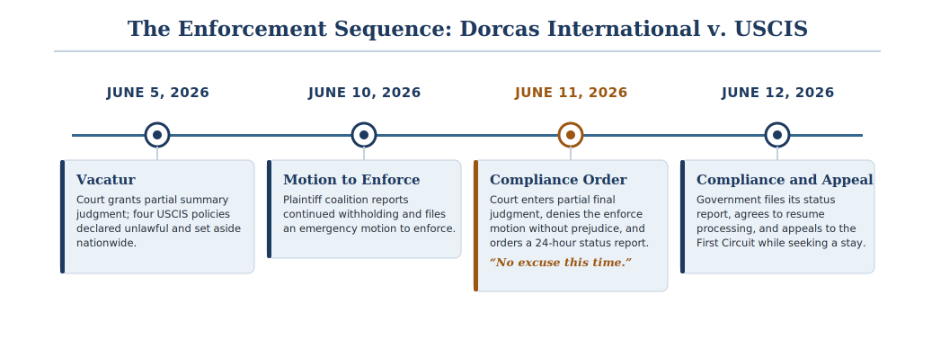
On June 11, 2026, Chief Judge John J. McConnell, Jr. of the United States District Court for the District of Rhode Island issued a terse enforcement order directing the federal government to comply at once with the decision he had entered one week earlier vacating four United States Citizenship and Immigration Services (USCIS) policies that had frozen the adjudication of asylum applications and a range of related immigration benefits. See Dorcas Int’l Inst. of R.I. v. U.S. Citizenship & Immigr. Servs., No. 1:26-cv-00132-JJM-PAS (D.R.I. June 11, 2026) (order entering partial final judgment and directing 24-hour compliance status report). The order followed a representation by the plaintiff coalition that, six days after the court had set the challenged policies aside, the agency was still withholding decisions. The court wrote that there was no excuse this time and that the government had an obligation to comply immediately. This article examines the enforcement sequence, the government’s response, and what the episode means for asylum applicants whose cases had been suspended, including the post-Soviet nationals who make up much of our practice. We addressed the underlying June 5 decision in a prior article on this site, and the present discussion assumes familiarity with it.
Background: The June 5 Vacatur
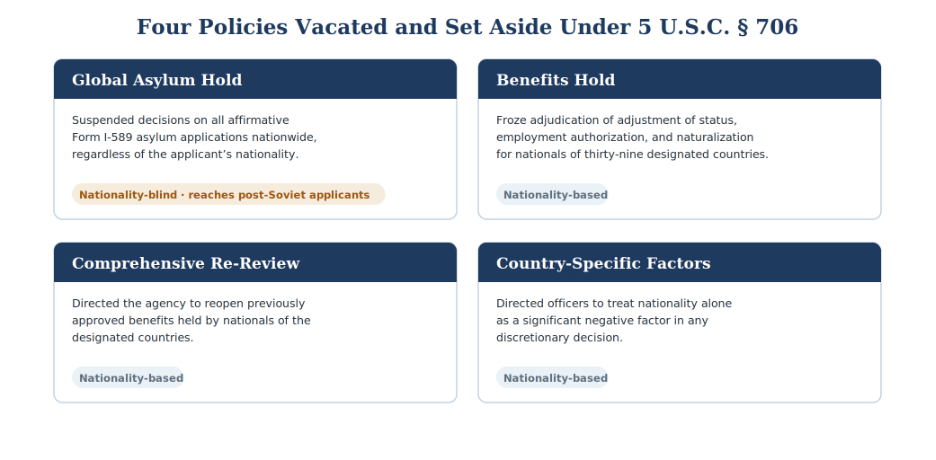
On June 5, 2026, the court granted summary judgment in part to the plaintiffs, a coalition of labor unions and nonprofit immigration service providers, and declared unlawful four interrelated USCIS measures rolled out beginning in late 2025. The Global Asylum Hold Policy suspended decisions on all affirmative asylum applications filed on Form I-589 without regard to the applicant’s nationality. The Benefits Hold Policy froze adjudication of adjustment of status, employment authorization, and naturalization for nationals of thirty-nine countries subject to the administration’s entry restrictions. The Comprehensive Re-Review Policy directed the agency to reopen previously approved benefits for those nationals, and the Country-Specific Factors Policy supplied the rationale tying the holds to nationality. The court held each policy contrary to law and arbitrary and capricious under the Administrative Procedure Act, see 5 U.S.C. § 706(2)(A), and vacated and set them aside. Dorcas, No. 1:26-cv-00132-JJM-PAS (D.R.I. June 5, 2026).
The entry restrictions themselves rested on the President’s authority under INA § 212(f), 8 U.S.C. § 1182(f), the same provision the Supreme Court sustained in Trump v. Hawaii, 585 U.S. 667 (2018). The court drew a careful line, however, between the power to suspend entry at the border and the agency’s separate refusal to adjudicate the domestic applications of noncitizens already lawfully present and pursuing relief. For the asylum bar, the holding rests on statutory text. Congress directed that, absent exceptional circumstances, the final administrative adjudication of an asylum application, not including administrative appeal, shall be completed within 180 days, INA § 208(d)(5)(A)(iii), 8 U.S.C. § 1158(d)(5)(A)(iii), and the court read the repeated use of the word “shall” as imposing a nondiscretionary duty to decide rather than a license to defer indefinitely.[1]
The June 11 Enforcement Order
On June 10, the plaintiffs returned to court with an emergency motion to enforce, representing that the government continued to withhold citizenship, green cards, work permits, and other benefits notwithstanding the vacatur. The government, for its part, asked the court to enter a final judgment or to clarify whether it had issued a coercive order, stating that once the court did so it would treat the relevant policies as vacated or enjoined. Judge McConnell was unpersuaded. In a six-page order he reiterated that the challenged policies were no longer in effect, stating in plain terms that they were vacated, set aside, cancelled, annulled, revoked, and voided. He gave the government twenty-four hours to file a status report describing the concrete steps it had taken to comply. The phrase that headlines this article, that there was no excuse this time, captured the court’s view that its June 5 order had been unambiguous and self-executing.[2]
Compliance Under Protest and the Notice of Appeal
Within the twenty-four hour window, the government filed a status report on June 12, 2026, accompanied by a declaration outlining the steps the agencies were taking to comply with the June 5 order.[3] Contemporaneous reporting confirmed that the administration had agreed to resume processing of asylum and immigration applications for nationals of the affected countries.[4] USCIS, in a public alert acknowledging the order, stated that it strongly disagreed with the decision but would comply while it considered further judicial review.[5] Consistent with that posture, the government noticed its appeal to the United States Court of Appeals for the First Circuit and had separately sought a stay of the order pending appeal.[6] Compliance, in short, came under protest and without any concession on the merits.
Mandatory Duties, Vacatur, and the Stay Question
Three features of the posture warrant attention. The first is the nature of the remedy. The court did not enter a classic injunction; it vacated the policies under the Administrative Procedure Act, which directs a reviewing court to “set aside” unlawful agency action. See 5 U.S.C. § 706(2). A vacatur operates on the rule itself rather than on named parties, so its practical effect is nationwide. That distinction carries weight after Trump v. CASA, Inc., 606 U.S. 831 (2025), which curtailed the universal injunction while expressly reserving the question whether APA vacatur is subject to the same limitation. The Dorcas court proceeded on the understanding that a set-aside under Section 706 reaches the vacated policies wholesale, and the June 11 order pressed that understanding to its conclusion: if the policies are void, the agency must act as though they had never issued. Readers interested in the longer arc of this debate may consult our discussion of Justice Thomas’s concurrence on nationwide injunctions in the travel-ban litigation.
The second feature is the mandatory-duty holding. Because the asylum statute speaks in the language of obligation, INA § 208(d)(5)(A)(iii), the agency may not convert a statutory processing timeline into an open-ended hold. The same is true of statutory withholding of removal and of protection under the Convention Against Torture, each of which is mandatory once eligibility is established. The court’s reasoning therefore reaches well beyond the thirty-nine designated countries, because the Global Asylum Hold was nationality-blind by its own terms.
The third feature is the stay question. A notice of appeal does not, standing alone, suspend a vacatur, and the district court declined to treat its order as anything other than presently effective. Whether the First Circuit, or the Supreme Court on a later application, grants a stay will determine how durable the resumption proves to be. The resumption also unfolds against the administration’s continued pursuit of other asylum restrictions, including a draft rule that would permit rejection of certain applications without an interview.[7] Practitioners should not assume that the present state of affairs is settled.
Practical Implications
For our clients, the immediate consequence is that affirmative asylum applications that had been suspended should now move back into adjudication. The point worth emphasizing, as we observed when the decision first issued, is that the Global Asylum Hold did not turn on nationality. It froze every pending affirmative Form I-589, which is precisely why it reached our Russian, Belarusian, Ukrainian, Georgian, Tajik, and other post-Soviet asylum applicants even though those countries do not appear on the entry-restriction list. The vacatur of that hold, and the June 11 order compelling compliance with it, are the parts of this litigation most directly relevant to that caseload.
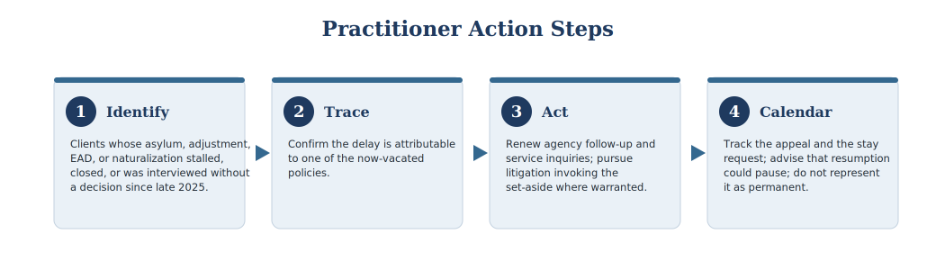
Several practical steps follow. Counsel should identify clients whose affirmative asylum, adjustment, employment authorization, or naturalization matters stalled, were administratively closed, or proceeded to interview without a decision since late 2025, and should determine whether the delay is attributable to one of the now-vacated policies. Where it is, the vacatur supplies a concrete basis for renewed agency follow-up, including service inquiries and, where warranted, litigation invoking the set-aside. At the same time, counsel should calendar the appeal and the pending stay request, advise clients that the resumption could be paused if a stay issues, and refrain from describing the current posture as permanent. Applicants from the thirty-nine designated countries face an additional layer of complexity, because the underlying entry restrictions under INA § 212(f) remain in force even though the domestic adjudication holds have been set aside. The distinction the court drew, between exclusion at the border and adjudication of benefits for those already present, is the line that will govern those cases. We will continue to monitor the appeal and update this analysis as the First Circuit acts.