
- Introduction
- The Two Worlds of Removal: Admission and Inadmissibility
- The Returning Resident and the Six Exceptions
- From a New Jersey Indictment to the Supreme Court
- The Court’s Two-Step Reading of the Statute
- The Standard of Proof, and Where the Court Said the Second Circuit Went Wrong
- The Dissent: A Blank Check and a Demotion Without Proof
- What the Decision Settles, and What It Leaves Open
- Practical Implications for Permanent Residents and the System
- Practical Implications for the Returning Resident in Particular
- A Concluding Word
Introduction
For most of the people who carry one, a green card feels like a settled fact. It is the document that says a person belongs here, that a trip to visit family abroad is just a trip, and that coming home is coming home. On June 23, 2026, the Supreme Court reminded the country that the law underneath that feeling is more fragile than it looks. In Blanche v. Lau, 609 U.S. , (2026) (slip op., at 5), the Court held by a vote of six to three that immigration officers at the border do not need clear and convincing evidence that a returning lawful permanent resident has committed a disqualifying crime before they treat that resident as someone knocking on the door for the first time rather than someone who already lives inside.1
The distinction sounds technical, and in one sense it is. But it carries enormous weight. A permanent resident who is treated as already admitted enjoys the more forgiving rules that govern deportation, and the government must shoulder the burden of proving that the resident should be removed. A permanent resident who is instead treated as an applicant for admission falls under the stricter rules of inadmissibility, can be detained or paroled on the spot, and may find that the burden of proof has quietly shifted onto his own shoulders. The question in Lau was how much the government must show, and when, before it may push a returning resident across that line. The Court’s answer was that, at the border, the government need show very little.
This article explains how the Court reached that result, why three Justices thought it was badly wrong, and what it means in concrete terms both for the immigration system and for the individual resident who has a criminal charge, an old arrest, or a pending case in his past. The law here rewards careful planning and punishes the traveler who assumes that a green card is a guarantee. Understanding the decision is the first step toward protecting against it.
The Two Worlds of Removal: Admission and Inadmissibility
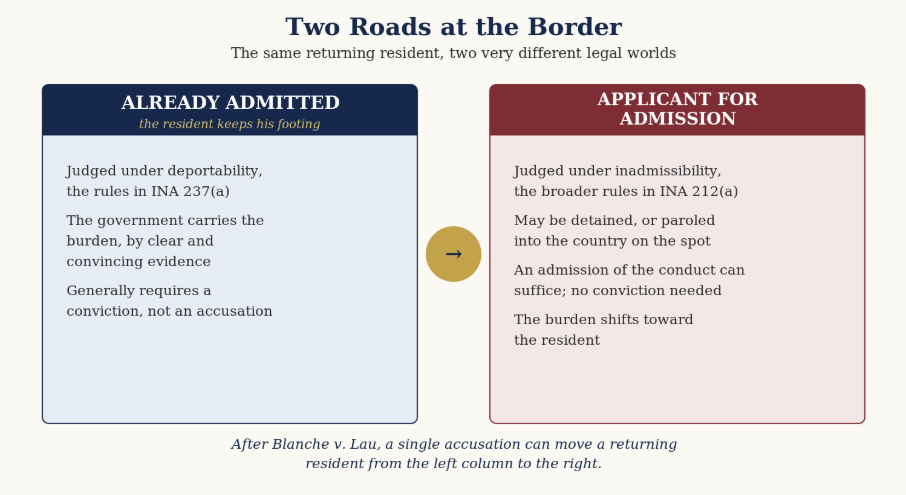
To see what Lau decided, it helps to understand a basic division that runs through American immigration law. The Immigration and Nationality Act sorts noncitizens who face removal into two worlds. People who have never been admitted to the United States, or who are stopped while seeking admission at the border, are judged under the grounds of inadmissibility in section 212(a) of the Act, 8 U.S.C. 1182(a). People who have already been admitted and are living in the country are judged under the separate grounds of deportability in section 237(a), 8 U.S.C. 1227(a). For a useful overview of how the criminal grounds differ across these two regimes, see the firm’s discussions of Inadmissibility for Criminal and Related Grounds and the Section 237 Deportability Statutes for general crimes.
The choice of world matters in ways that decide cases. The grounds of inadmissibility are broader and easier for the government to invoke. A single admission of the essential elements of a crime involving moral turpitude can render a person inadmissible under section 212(a)(2)(A)(i)(I), 8 U.S.C. 1182(a)(2)(A)(i)(I), even without a conviction, while the criminal grounds of deportability generally require a conviction. Just as important, the burden of proof points in opposite directions depending on which world a person occupies. When the government seeks to remove a noncitizen who has already been admitted, it must prove deportability by clear and convincing evidence under section 240(c)(3)(A) of the Act, 8 U.S.C. 1229a(c)(3)(A). When a noncitizen is instead an applicant for admission, the statute places the burden on that person to prove that he is clearly and beyond doubt entitled to be admitted under section 240(c)(2), 8 U.S.C. 1229a(c)(2).
For a returning lawful permanent resident, then, the label is the ballgame. Treated as already admitted, he keeps the protections of the deportability regime, and the government carries the load. Treated as an applicant for admission, he loses those protections, may be detained or released only on parole, and may have to prove his own right to stay. The firm has written at length about why a returning permanent resident generally cannot be treated as seeking admission, and about the meaning of a lawful admission in the first place. Lau is about the narrow seam where those two worlds meet at the airport inspection booth.
The Returning Resident and the Six Exceptions
It was not always this clean. Before 1996, the governing concept was entry, and the Supreme Court had softened the harshness of that idea in Rosenberg v. Fleuti, 374 U.S. 449 (1963), which held that a permanent resident who took an innocent, casual, and brief trip abroad did not make a new entry on return and so could not be treated as though arriving for the first time. The Illegal Immigration Reform and Immigrant Responsibility Act of 1996, Pub. L. No. 104-208, 110 Stat. 3009, replaced the concept of entry with the concept of admission and wrote a specific rule for returning residents into the statute. The Board of Immigration Appeals later concluded that this change displaced the Fleuti doctrine as a matter of statutory law. See Matter of Collado-Munoz, 21 I&N Dec. 1061 (BIA 1998).
The rule Congress wrote lives in section 101(a)(13)(C) of the Act, 8 U.S.C. 1101(a)(13)(C). It begins with a promise. A lawful permanent resident, defined in section 101(a)(20), 8 U.S.C. 1101(a)(20), shall not be regarded as seeking admission when returning from a trip abroad. Then it lists six situations that take that promise away. A resident may be treated as seeking admission if he has abandoned or relinquished his status, if he has been absent for a continuous period of more than 180 days, if he engaged in illegal activity after leaving the country, if he departed while in removal or extradition proceedings, if he committed an offense identified in the criminal inadmissibility grounds of section 212(a)(2) and has not obtained a waiver or relief, or if he is attempting to enter without inspection. The fifth of these exceptions, set out in section 101(a)(13)(C)(v), 8 U.S.C. 1101(a)(13)(C)(v), is the one that decided Lau.
Read the text of that fifth exception closely, because the whole case turns on a single verb. The statute permits the government to treat a returning resident as seeking admission when the resident has committed an offense identified in section 212(a)(2). It says committed. It does not say convicted. For years, practitioners and the Board alike had assumed that the government still had to prove its way across this line with real evidence, and that a returning resident with deep ties and a clean adjudicated record could not be casually demoted on the strength of an accusation. The firm’s analysis of when permanent residents cannot be considered to be seeking admission reflects that traditional understanding. Lau tested how much weight that single word, committed, could bear.
From a New Jersey Indictment to the Supreme Court
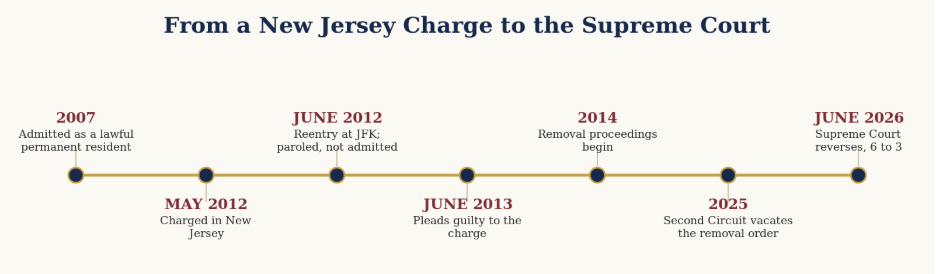
Muk Choi Lau is a citizen of China who became a lawful permanent resident of the United States in 2007. In May 2012, New Jersey authorities charged him under state law with trademark counterfeiting, accusing him of selling roughly 300,000 dollars worth of counterfeit shorts. See N.J. Stat. Ann. 2C:21-32. The charge was an accusation, not a conviction. While it was pending, and before any court had found him guilty of anything, Lau took a trip to China.1
When he returned and presented himself to an officer at the airport on June 15, 2012, the encounter that followed is the heart of the case. Rather than admit him in the ordinary course, the officer treated Lau as an applicant for admission and paroled him into the country under section 212(d)(5)(A) of the Act, 8 U.S.C. 1182(d)(5)(A). Parole let him enter physically to face his New Jersey prosecution, but it deferred any decision about whether he was actually entitled to be admitted. As the firm explains in its overview of parole, parole is a kind of legal fiction. The person is allowed in, yet for purposes of the immigration laws he is treated as though he is still standing at the threshold, never admitted.
About a year later, Lau pleaded guilty to the trademark counterfeiting charge. He was convicted and sentenced to two years of probation. The Department of Homeland Security then placed him in removal proceedings, arguing that his conviction was a crime involving moral turpitude that made him inadmissible under section 212(a)(2). Lau’s defense was not that the conviction was harmless. It was that the government had mislabeled him at the very start. He argued that he should have been admitted in June 2012, like any other returning resident, and that the proper course would have been to charge him as a deportable permanent resident, which would have forced the government to carry the heavier burden that the deportability regime imposes.1
An immigration judge and the Board of Immigration Appeals rejected that argument. The United States Court of Appeals for the Second Circuit did not. It held that immigration officers must possess clear and convincing evidence that a disqualifying crime has been committed before they may decline to admit a returning permanent resident, and it concluded that the officers who paroled Lau in 2012 did not have evidence meeting that standard when all they had was a pending charge. See Muk Choi Lau v. Bondi, 130 F.4th 42, 46-47 (2d Cir. 2025). Because that decision conflicted with rulings of the Fifth and Ninth Circuits, which had let the government treat a returning resident as an applicant for admission based on the commission of an offense, the Supreme Court agreed to resolve the split. See Luz Munoz v. Holder, 755 F.3d 366, 370-71 (5th Cir. 2014); Vazquez Romero v. Garland, 999 F.3d 656, 664 (9th Cir. 2021). The Justices heard argument on April 22, 2026, against the backdrop of a national debate about immigration enforcement.2
The Court’s Two-Step Reading of the Statute
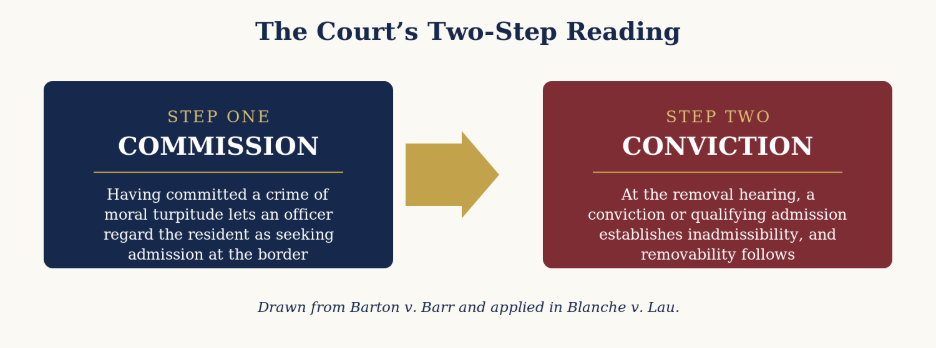
Justice Thomas wrote for a majority that included the Chief Justice and Justices Alito, Gorsuch, Kavanaugh, and Barrett. The opinion was short, nine pages, and its logic was built almost entirely on the text of the returning-resident exception. The majority broke the removal of a returning resident on a criminal charge into two distinct steps, and it insisted that the parties and the Second Circuit had blurred them together. The two-step framing was not invented for this case. The Court drew it from Barton v. Barr, 590 U.S. 222 (2020), which had already distinguished the commission of an offense from a later conviction in a related corner of the immigration laws. See Blanche, slip op. at 5-6.
At the first step, the question is only whether the government may regard the resident as someone seeking admission. The statute answers that question by reference to commission. Under section 101(a)(13)(C)(v), the government may treat a returning resident as seeking admission once he has committed an offense identified in section 212(a)(2). In the majority’s words, a straightforward reading of the text contradicts the contrary view, because the government may regard a lawful permanent resident as seeking admission as soon as he committed a crime involving moral turpitude, even if, as in Lau’s case, the conviction occurred later. Blanche, slip op. at 9. The label attaches at the moment of the act, not at the moment a court enters judgment.
At the second step, the question is whether the resident, now treated as an applicant for admission, is actually inadmissible and therefore removable. That step is governed by the criminal inadmissibility grounds, and there the statute does demand more. To find a person inadmissible for a crime involving moral turpitude under section 212(a)(2)(A)(i)(I), the government ordinarily needs a conviction or a qualifying admission of the conduct. The conviction Lau later entered supplied exactly that. So in the majority’s framework, the accusation was enough to move him into the applicant-for-admission world at step one, and the subsequent conviction was enough to establish his inadmissibility at step two.
The appeal of the two-step reading, from the majority’s point of view, is that it lets the border officer act in real time without prejudging the ultimate question. The officer does not decide in the inspection booth whether the traveler is guilty. The officer decides only whether there is a basis to set the traveler on the inadmissibility track and to defer the merits to a later proceeding. The Board of Immigration Appeals had blessed a version of this sequence before, allowing the government to parole a returning resident for criminal prosecution and then rely on the resulting conviction in removal proceedings. See Matter of Valenzuela-Felix, 26 I&N Dec. 53 (BIA 2012). Lau elevated that practice to a reading of the statute itself.
The Standard of Proof, and Where the Court Said the Second Circuit Went Wrong
The Second Circuit’s mistake, as the majority saw it, was importing a standard of proof from the wrong place. The clear and convincing evidence requirement does appear in this corner of the law, but it appears at the removal hearing, not at the border. When a person is placed in proceedings and claims the protections of a lawful permanent resident, the government must prove by clear and convincing evidence that the person is in fact an applicant for admission, meaning that one of the six exceptions applies. That allocation comes from Board precedent. See Matter of Rivens, 25 I&N Dec. 623 (BIA 2011). The heightened standard for removal more generally traces back to Woodby v. INS, 385 U.S. 276 (1966), which required clear, unequivocal, and convincing evidence before a person could be deported.
The majority drew a sharp line between that hearing-stage burden and the spot decision an officer makes at the port of entry. Nothing in the Act, Justice Thomas wrote, imposes a clear and convincing evidence burden on the officer who must decide on the spot how to treat an arriving traveler. That burden, he explained, came from inapposite Board precedent that addressed the evidence the government must have during a removal hearing, not during an encounter at the border. The precedent the majority had in mind was Matter of Valenzuela-Felix, 26 I&N Dec. 53, 57, 64 (BIA 2012), which fixed the government’s burden at the removal hearing rather than at the port of entry. The Court declined to read into the statute an additional clear and convincing evidence burden on border officers entrusted with making quick judgments on the spot when that burden is nowhere in the statute or even in Board precedent. Blanche, slip op. at 6-7.
The majority also brushed aside two of Lau’s narrower points. It rejected his claim that the government had expressly conceded that the clear and convincing standard applied at the border, reading the supposed concession as limited to the removal hearing. And it rejected his argument that a person cannot be said to have committed a crime involving moral turpitude until he is convicted of one. Lau had drawn that point from a footnote in Vartelas v. Holder, 566 U.S. 257, 275 n.11 (2012), but the majority read the returning-resident exception as incorporating only the crimes that section 212(a)(2) identifies, not its separate requirement of a conviction, so that commission and conviction are different events and the statute keys the border classification to the former. The result was a decision to vacate the Second Circuit’s judgment and return the case for further proceedings consistent with the two-step reading.
The Dissent: A Blank Check and a Demotion Without Proof
Justice Jackson dissented in an opinion joined by Justices Sotomayor and Kagan. At seventeen pages, the dissent was nearly twice the length of the majority opinion, and its tone was urgent. The text, structure, and context of the Act, she argued, should have led the Court to the opposite conclusion. Under the plain terms of the statute, she wrote, the government has no discretion to deny a returning permanent resident admission when it does not yet have the evidence to justify that decision, and the removal hearing, which can come months or even years after the resident is demoted and paroled in, is too late for the government to carry its burden. Blanche, slip op. at 2-3 (Jackson, J., dissenting).1
The center of the dissent was the human cost of the label the majority treated as a mere way station. A demotion to the status of someone seeking admission, Justice Jackson insisted, is not costless. Blanche, slip op. at 8 (Jackson, J., dissenting). It exposes the resident to immediate detention or release only on parole. The downsides of detention are obvious, she wrote, and even parole carries serious negative repercussions, including the loss of the physical green card and the ability to work. In her account, the majority had taken a status that Congress designed to be secure and made it contingent on nothing more than an officer’s reaction to an accusation.
She framed the stakes in the language of a principle older than the immigration code. It is a fundamental maxim in our country, she wrote, that all are innocent until proven guilty. Yet Lau was divested of his already-admitted status, deemed an applicant for admission, and paroled solely on the basis of an indictment. Blanche, slip op. at 17 (Jackson, J., dissenting). Congress, she concluded, could not have meant for the guarantees that come with permanent residence to be so cavalierly swept aside. Her most quoted line warned that the Court had handed the government a massive blank check to place permanent residents in immigration limbo, undermining the benefits and security that come with having a green card. Id., slip op. at 17.1
Commentators sympathetic to the dissent went further, describing the government’s litigating posture as a kind of switch. They argued that the Solicitor General had won by recasting at the Supreme Court a position the government had taken more modestly below, so that a concession about the removal hearing was quietly converted into a victory at the border.3 Others warned that the decision degraded the rights of permanent residents in a way that would be felt well beyond the unusual facts of Lau’s own case.4
What the Decision Settles, and What It Leaves Open
It is worth being precise about the reach of the holding, because both relief and alarm can be overstated. Lau settles that an officer at a port of entry may treat a returning permanent resident as an applicant for admission based on the commission of a section 212(a)(2) offense without first assembling clear and convincing evidence, and that an accusation such as a pending charge can support that initial classification. The Court was careful about what it did not decide. It expressly reserved whether the government bears any burden at all at the border, suggesting that if one exists it might require no more than a showing to the satisfaction of the inspecting officer. Blanche, slip op. at 7 n.2. It confirms that the government may park the merits, parole the resident in, and rely later on a conviction or qualifying admission to establish inadmissibility at the removal hearing.
The decision does not erase the protections that returning residents retain at the hearing stage. When the case reaches an immigration judge and the resident asserts his status, the government still must prove by clear and convincing evidence that one of the six exceptions in section 101(a)(13)(C) applies, as Matter of Rivens requires. A bare accusation that never ripens into a conviction or a competent admission may still fail at that stage. Lau himself lost only because his charge became a conviction. A resident whose charge is dismissed, or who is acquitted, stands on very different ground when the merits are finally tested.
Nor does the decision strip away the constitutional floor beneath returning residents. The Supreme Court has long recognized that a permanent resident returning from a brief trip is not in the same position as a stranger at the gate, and that such a resident is entitled to due process in the proceedings that decide his fate. See Landon v. Plasencia, 459 U.S. 21 (1982); Kwong Hai Chew v. Colding, 344 U.S. 590 (1953). Lau is a decision about a standard of proof and the timing of a classification. It is not a decision that returning residents may be removed without a fair hearing. What it changes is the leverage each side holds when that hearing finally arrives, and the vulnerability the resident faces in the long interval before it does.
Practical Implications for Permanent Residents and the System
In practical terms, Lau shifts power toward the government at the precise moment when a traveler is least able to resist. The inspection booth is not a courtroom. There is no judge, no lawyer, and no record, and the traveler is tired and eager to get home. By holding that an officer may demote a returning resident on the strength of an accusation, the Court has made that brief and lonely encounter far more consequential than most green card holders realize. The firm’s discussion of the dangers of criminal convictions for lawful permanent residents now extends, after Lau, to mere charges that have not yet been resolved.
Three system-level consequences follow. First, expect more returning residents with any criminal history to be paroled rather than admitted, and to be funneled into removal proceedings while their cases are sorted out. Parole is not admission, and a paroled resident can be detained and can face the loss of work authorization and the surrender of the physical green card during the long wait. The firm’s treatment of how paroled arriving aliens are handled, including detention authority and bond, becomes required reading for anyone caught in this posture.
Second, the decision raises the stakes of every unresolved criminal matter. A pending charge, an old arrest that was never fully adjudicated, or a conviction the resident believed was minor can now become the trigger for a demotion at the border. Because the inadmissibility grounds can reach conduct that the deportability grounds would not, a resident may discover that the same record produces a harsher outcome simply because he traveled. The firm’s overview of inadmissibility on criminal and related grounds explains why the two regimes are not interchangeable.
Third, the burden of proof, which sits at the heart of the case, will quietly determine outcomes. At the hearing the government still must prove the applicability of an exception by clear and convincing evidence, and a resident who understands that allocation can hold the government to it. But the resident who does not assert his status, who answers questions freely at the booth, or who treats the proceeding as a formality may forfeit protections he did not know he had. The lesson of Lau for the system is that the contest has moved earlier and become quieter, and that the resident who is unrepresented and uninformed is the one most likely to lose it.
Practical Implications for the Returning Resident in Particular
For the individual permanent resident who has any criminal history, the practical advice that flows from Lau is concrete and worth taking seriously before booking a trip. The first step is an honest audit of one’s own record. Any arrest, charge, or conviction, no matter how old or how minor it felt at the time, should be reviewed with an immigration attorney to determine whether it could be characterized as a crime involving moral turpitude or a controlled substance offense under section 212(a)(2). A pending charge deserves the same caution as a conviction, because Lau makes the accusation itself a basis for demotion at the border.
The second step is to think hard about travel itself. After Lau, international travel is the event that converts a quiet record into an active immigration problem. A resident with an unresolved charge or a qualifying conviction should weigh whether a trip abroad is necessary at all until the criminal matter is fully resolved and its immigration consequences are understood. For many residents in this position, the safest course is to consult counsel before departure rather than to discover the problem at the inspection booth on return. Practitioner advisories issued in the wake of the decision have made the same point, urging green card holders with any criminal exposure to obtain legal advice before leaving the country.5 The risks of travel for this group are now widely recognized in the field.6
The third step concerns what to do if the demotion happens anyway. A resident who is told at the airport that he is being paroled rather than admitted should understand that he has not lost his case, only his easy footing. He should not sign documents he does not understand, should not concede that he is an applicant for admission, and should affirmatively assert his status as a lawful permanent resident at the earliest opportunity. At the removal hearing, the government still must prove by clear and convincing evidence that an exception in section 101(a)(13)(C) applies, and a charge that has not become a conviction may not carry that burden. Counsel can also evaluate whether relief is available, including a waiver of inadmissibility where the facts permit, as discussed in the firm’s materials on waivers of inadmissibility, or cancellation of removal for long-resident green card holders, addressed in the firm’s overview of cancellation of removal for lawful permanent residents.
The fourth step is a longer one, and it is about cleaning up the past. Because a conviction is what ultimately sank Lau at the second step of the Court’s framework, the strength or weakness of the underlying criminal judgment can decide the immigration case. A resident with a questionable plea should ask counsel whether post-conviction relief is realistic, since a vacatur granted for a genuine legal defect, rather than for immigration convenience, can remove the very foundation the government needs. The Supreme Court’s recognition that immigration consequences are central to criminal plea decisions, reflected in the firm’s discussion of vacating a conviction based on ineffective assistance, gives some residents a path that did not exist a generation ago.
For Lau himself, the decision is close to the end of a long road. His charge became a conviction, the conviction is a crime involving moral turpitude, and the Court has now blessed the sequence by which the government used his return from China to place him on the inadmissibility track. On remand his best arguments are narrow ones, directed at whether his particular offense truly qualifies as a crime involving moral turpitude and at whether any waiver or form of relief remains open to him. For the far larger group of permanent residents who are watching his case from a distance, the more important point is preventive. The difference between a routine reentry and a removal proceeding may come down to a decision made before a trip is ever booked, and to whether the resident understood, in advance, that the law no longer treats a green card as a promise that the door will always open from the inside.
A Concluding Word
Blanche v. Lau does not announce that permanent residents have lost their status, and it does not license removal without a hearing. What it does is more subtle and, for that reason, more dangerous to the unprepared. It moves the decisive moment forward in time, from the hearing where a resident has a lawyer and a record to the inspection booth where he has neither, and it tells the officer there that an accusation is enough. The three dissenting Justices saw in that shift a blank check and a betrayal of the security a green card was supposed to provide. Whether or not one shares that view, the practical message for residents is the same. Know your record, plan your travel, assert your status, and do not assume that the protections of permanent residence will assert themselves on your behalf. After Lau, they will not.
- Kelsey Dallas, Court Sides With Government in Dispute Over Rights of Green Card Holders Accused of Committing a Crime, SCOTUSblog (June 23, 2026). The direct quotations from the majority opinion and the dissent reproduced in this article are as reported in that account of the decision.
- Kelsey Dallas, Justices Debate Rights of Lawful Permanent Residents Against Backdrop of Trump’s Immigration Crackdown, SCOTUSblog (Apr. 23, 2026).
- See In Blanche v. Lau, the Supreme Court Rewards the Solicitor General’s Bait-and-Switch at Green Card Holders’ Expense, Just Security (2026).
- See Cyrus D. Mehta, Blanche v. Lau: The Supreme Court Has Degraded the Rights of Lawful Permanent Residents, The Insightful Immigration Blog (June 2026).
- See Supreme Court Addresses Rights of Green Card Holders in Blanche v. Lau, Ogletree Deakins (2026).
- See International Travel Risks for Green Card Holders After Blanche v. Lau (2026), Reddy Neumann Brown PC.