
Introduction
Section 287(g) of the Immigration and Nationality Act, codified at 8 U.S.C. § 1357(g), authorizes the Secretary of Homeland Security to enter into written agreements that delegate specified federal immigration enforcement functions to state and local law enforcement officers, who act under the direction and supervision of U.S. Immigration and Customs Enforcement (ICE). The authority was added to the Act by the Illegal Immigration Reform and Immigrant Responsibility Act of 1996, Pub. L. No. 104-208, div. C, tit. I, § 133, 110 Stat. 3009-546, 3009-563 (1996). The program has expanded rapidly during the current administration, and recent press reporting has drawn renewed public attention to how it functions during routine policing. This article summarizes the structure of the program, the federal incentives now offered to participating agencies, and the figures reported in recent coverage, and it notes the practical implications for noncitizens. For our earlier treatment of the program’s recent growth, see Surge in Local Law Enforcement Partnerships with ICE: The 287(g) Program’s Record Growth and Implications for Immigration Compliance.
Statutory Framework and the Three Operating Models
Under a Memorandum of Agreement (MOA), ICE may delegate immigration authority to designated officers within a participating agency. ICE currently administers three models. The Jail Enforcement Model (JEM) operates within correctional facilities and applies to individuals already arrested and booked on state or local charges. The Warrant Service Officer (WSO) program authorizes designated officers to serve and execute administrative immigration warrants on individuals already in their agency’s custody; for our coverage of the program’s introduction, see ICE Starts Warrant Service Officer Program. The Task Force Model (TFM) is the broadest of the three. It permits trained officers to question individuals about immigration status during routine duties, including traffic stops, and, with ICE coordination, to arrest and transfer individuals to federal custody. The statute conditions this delegation on officers having knowledge of, and receiving adequate training in, federal immigration law. 8 U.S.C. § 1357(g)(2).
Administrative detainers issued in connection with these models are requests governed by 8 C.F.R. § 287.7, not warrants issued by a judicial officer, a distinction that several state attorneys general have emphasized in guidance to local agencies. The powers and authority of immigration officers, including questioning and arrest authority that designated officers exercise by delegation, are described at 8 C.F.R. § 287.5. A current roster of participating jurisdictions appears in our List of Current Section 287(g) Agreements Between ICE and Local Authorities.
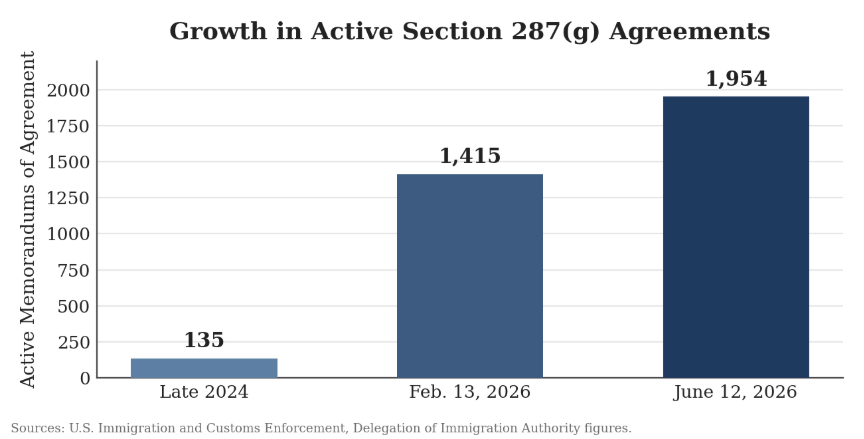
According to ICE, the number of active agreements has grown sharply. The agency reported 1,415 active MOAs across forty states as of February 13, 2026, the figure cited in our earlier coverage, and 1,954 MOAs covering thirty-nine states and two United States territories as of June 12, 2026.1 By comparison, roughly 135 agreements were in effect before the current administration’s expansion began.2 The same ICE accounting attributes the largest share of recent growth to the Task Force Model.
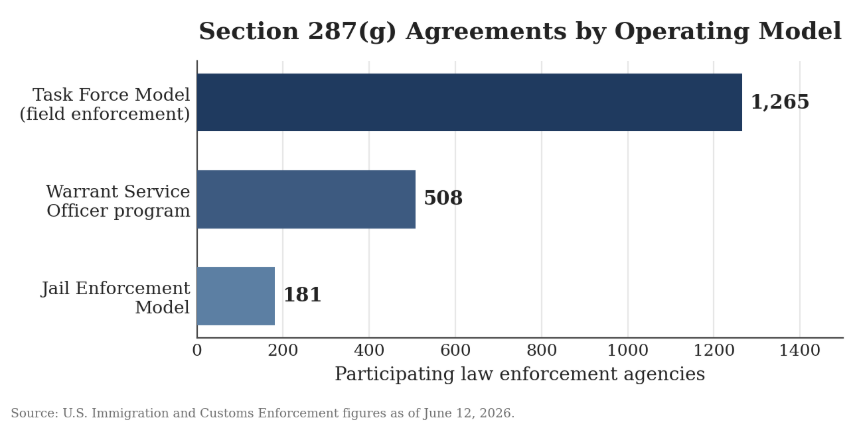
As of June 12, 2026, ICE reported Task Force Model agreements with 1,265 agencies, Warrant Service Officer agreements with 508 agencies, and Jail Enforcement Model agreements with 181 agencies.1 Many jurisdictions hold more than one type of agreement.
Training Requirements
The training required of designated officers differs by model. The Jail Enforcement Model continues to require a four-week course followed by a one-week refresher every two years.3 The revived Task Force Model, by contrast, requires a condensed forty-hour online course covering scope of authority, immigration and civil rights law, cross-cultural issues, liability, and complaint procedures, and it no longer takes place at the Federal Law Enforcement Training Center.4 Commentators have noted that the abbreviated curriculum represents a significant reduction from the historical four-week, in-person model.4
Federal Financial Incentives
The Department of Homeland Security has announced a set of financial incentives for participating agencies that observers describe as without close precedent in the program’s history.5 Reported terms include up to $100,000 per agreement for the purchase of new vehicles and up to $7,500 per trained task force officer for equipment such as a laptop and mobile device. ICE has also stated that it would reimburse the annual salary and benefits of eligible trained officers, with overtime coverage of up to twenty-five percent of salary, and that agencies would be eligible for quarterly performance awards tied to the share of ICE-identified individuals located.5
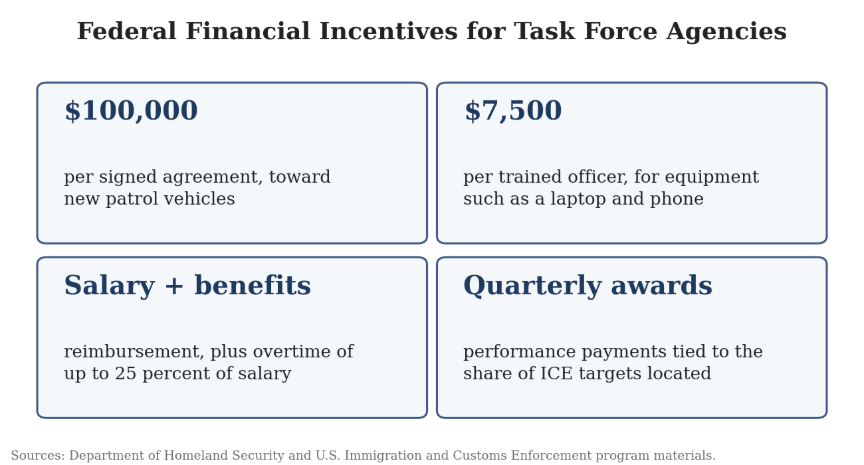
The performance-award structure has drawn attention. One participating sheriff in Pennsylvania reported that he declined to send officers through training after bonuses tied to the number of arrests were announced, citing a state law that prohibits arrest quotas.6 National law enforcement organizations, including the Fraternal Order of Police, have publicly supported the reimbursement models and encouraged agencies to consider all three program types.7
Recent Reporting on Field Operations
Recent press coverage has documented how the Task Force Model operates during ordinary traffic enforcement. In one widely circulated account, a reporter accompanied a five-hour traffic operation conducted by the Laramie County Sheriff’s Office in Wyoming. Over the course of the operation, deputies reported conducting forty-one vehicle stops, issuing twelve citations, making two criminal arrests, and producing seven immigration detentions.8
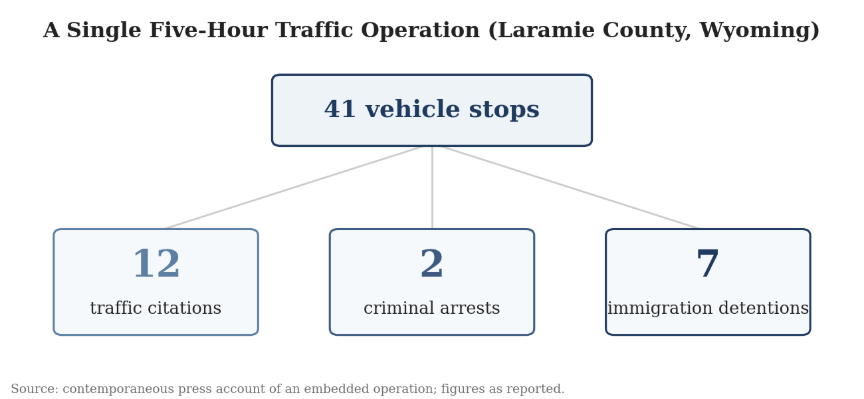
The same reporting indicated that the Laramie County office had recorded several hundred immigration detentions since October 2025 and had received roughly $300,000 in connection with its participation in the program.8 Locally released records reviewed by Wyoming news organizations are consistent with that picture. According to those records, the office reported that nearly seventy-six percent of its immigration arrests in the county originated in traffic stops, and that ninety-three case reports over the relevant period resulted in 154 total arrests.9 The sheriff stated that his deputies do not approach homes or workplaces on the basis of immigration status, that the majority of those detained were first contacted during stops on suspicion of a traffic or criminal violation, and that in some cases the office books individuals into the immigration process rather than charging an underlying local offense.9
Legal and Policy Context
Participation in the program is not uniform across the country. Several states have enacted statutes restricting or prohibiting 287(g) agreements, and others have long barred participation; in addition, at least one governor has proposed voiding existing agreements within the state.10 Civil liberties organizations have published reports arguing that field enforcement under the Task Force Model invites racial profiling and what they characterize as “show me your papers” policing, while supporters describe the program as a force multiplier that advances public safety.11 These competing characterizations track longstanding debates over the program. For an example of a large multi-agency operation conducted under 287(g) authority, see our coverage of ICE Enforcement Surges: West Virginia Operation and Nationwide Trends.
Practical Implications
For noncitizens, the practical significance of the Task Force Model is that an ordinary traffic stop in a participating jurisdiction may lead to questions about immigration status and, in some cases, to a transfer into immigration custody. This is true regardless of the nature of the underlying violation, and it can affect individuals across nationalities, including the post-Soviet communities our firm serves. Lawful status does not eliminate the relevance of these encounters, because lapses, violations, or unresolved matters can carry consequences for status, for the renewal of documents, and for future applications. Individuals who reside in a county with an active agreement may wish to confirm whether their jurisdiction participates, to maintain careful compliance with traffic laws, and to understand that an administrative detainer is a request governed by 8 C.F.R. § 287.7 rather than a judicial warrant. Anyone who is questioned or detained in connection with immigration status should consider seeking qualified legal counsel promptly.
- U.S. Immigration and Customs Enforcement, Delegation of Immigration Authority Section 287(g) Immigration and Nationality Act (reporting 1,954 signed Memorandums of Agreement covering thirty-nine states and two United States territories, including 181 Jail Enforcement Model agencies, 508 Warrant Service Officer agencies, and 1,265 Task Force Model agencies, as of June 12, 2026).
- Pre-expansion totals of roughly 135 agreements are reported in, e.g., American Oversight, ICE’s Work with Local Police Departments Is Being Kept Secret (Apr. 30, 2026); see also Latin Times, Critics Warn ICE Incentives Could Become ‘Lifeline’ for Cash-Strapped Police (May 6, 2026).
- Cong. Rsch. Serv., IF11898, The 287(g) Program: State and Local Immigration Enforcement (describing the four-week Jail Enforcement Model training and one-week biennial refresher).
- National Immigration Forum, Explainer: Training Under the Revived 287(g) Task Force Model (Dec. 8, 2025); Immigrant Legal Resource Center, Annotated 287(g) Task Force Model Agreement (Dec. 2025).
- U.S. Immigration and Customs Enforcement, Benefits of 287(g) (fact sheet); Fraternal Order of Police, Statement of National President Patrick Yoes Supporting 287(g) Program Partnerships (Sept. 17, 2025), (describing equipment, vehicle, salary, overtime, and quarterly performance-award terms).
- Montour County Sheriff: ICE Arrest Incentives Conflict with PA Law Prohibiting Quotas.
- Fraternal Order of Police, supra note 5; see also Nebraska Public Media, As ICE Partnerships Spread in the Midwest, Incentives Rise and Civil Rights Concerns Deepen.
- Press reporting on an embedded five-hour Laramie County, Wyoming, traffic operation (forty-one stops, twelve citations, two criminal arrests, and seven immigration detentions), with the office reporting several hundred immigration detentions since October 2025 and approximately $300,000 received in connection with the program. See The New York Times, How ICE Is Using Local Police for Immigration Arrests (interactive) (June 12, 2026).
- Wyoming Tribune Eagle, LCSO Reports Show Nearly 76% of County ICE Arrests Resulted from a Traffic Stop (Feb. 28, 2026); WyoFile, Laramie County Sheriff’s Deputies Making More Immigration Arrests Around Wyoming’s Largest City (Nov. 25, 2025).
- See, e.g., American Civil Liberties Union, ICE Is Rapidly Expanding Dangerous 287(g) Agreements with Local Police (Feb. 27, 2026), (noting state bans enacted in 2025 and 2026); Nexstar, What Is a 287(g) Agreement? (Feb. 3, 2026), (reporting a proposal to void existing New York agreements).
- American Civil Liberties Union, New ACLU Report Reveals How the Trump Administration Is Using Local Police to Build a National Deportation-Policing Force Through the 287(g) Program (Feb. 26, 2026); cf. Fraternal Order of Police, supra note 5 (describing the program as advancing community safety).