
Introduction
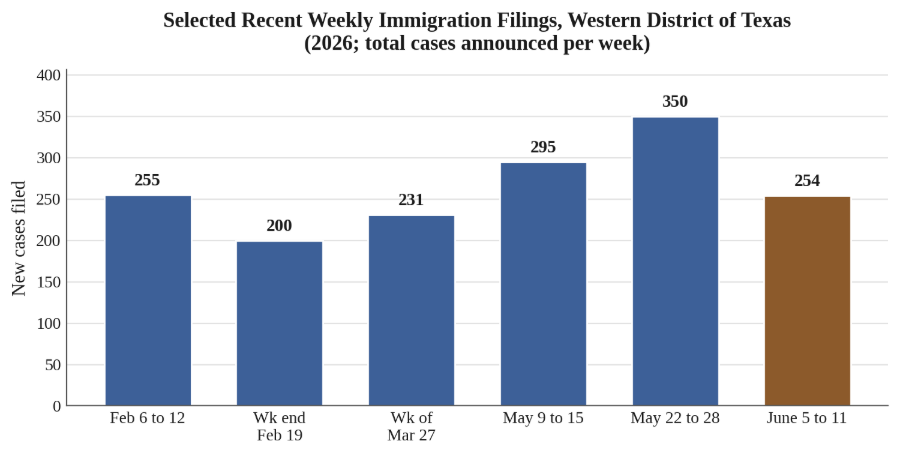
On June 12, 2026, the United States Attorney’s Office for the Western District of Texas announced that federal prosecutors had filed 254 new immigration and immigration related criminal cases over the week running from June 5 through June 11, 2026.1 The announcement, attributed to United States Attorney Justin R. Simmons, described charges brought against alleged human smugglers and against noncitizens with prior criminal records and multiple prior removals, including convictions for driving while intoxicated, theft, assault, and crimes against children. Local reporting noted that several of the new matters carried ties to the El Paso area.2 The filing forms part of a now familiar weekly enforcement cadence in the district, and it offers a useful occasion to review the criminal statutes that drive these prosecutions, the civil immigration consequences that frequently follow, and the practical significance of the trend for noncitizens and their families.
The Charge Breakdown and the Governing Criminal Statutes
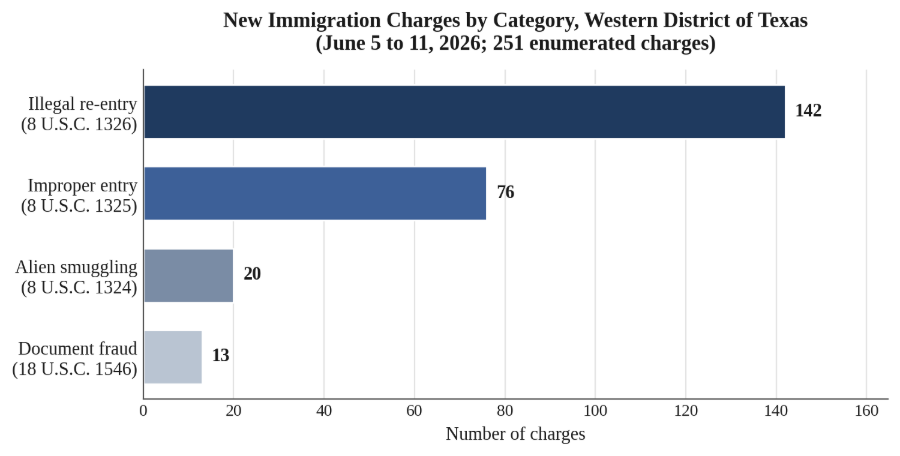
According to the announcement, the district wide charges broke down into four principal categories: 76 charges for improper entry by a noncitizen, 142 charges for illegal re-entry, 20 cases for alien smuggling, and 13 charges for fraud and misuse of visas, permits, and related documents, for a total of 251 enumerated charges.1 Each category corresponds to a distinct federal criminal provision, and the relative volume of the charges is itself instructive.
Improper entry is prosecuted under 8 U.S.C. § 1325, which makes it a federal offense for a noncitizen to enter or attempt to enter the United States at an improper time or place, or to elude examination or inspection. A first offense is a misdemeanor, while a subsequent conviction is punishable as a felony. Illegal re-entry, the largest single category here, is prosecuted under 8 U.S.C. § 1326, which penalizes a noncitizen who reenters or is found in the United States after a prior removal or deportation, with sentencing exposure that rises sharply when the prior removal followed certain criminal convictions. Alien smuggling is charged under 8 U.S.C. § 1324, which reaches bringing in, transporting, harboring, or shielding noncitizens, as well as conspiracy to do so. Document fraud of the kind described in the announcement is ordinarily charged under 18 U.S.C. § 1546, which addresses fraud and misuse of visas, permits, border crossing cards, and other entry documents.
That illegal re-entry accounts for well more than half of the week’s charges is consistent with longer term enforcement patterns. As we have previously reported, felony illegal re-entry prosecutions under Section 1326 have for years constituted one of the most frequently charged federal offenses, and improper entry charges under Section 1325 have at times numbered in the tens of thousands annually nationwide.3 The continued prominence of reinstatement related re-entry charges reflects the large population of noncitizens with prior removal orders who later return to the United States.
Representative Cases Identified in the Announcement
The announcement highlighted several individual matters. Four individuals were arrested near Socorro and charged by criminal complaint with alien smuggling after Border Patrol agents apprehended eight noncitizens who allegedly crossed the Rio Grande and climbed over the international boundary fence; investigators traced incoming calls to phone numbers associated with smuggling activity and identified three alleged coordinators of the planned pickup and an alleged fourth conspirator said to have served as the foot guide.1 A United States citizen was separately charged with alien smuggling for allegedly attempting to transport two Mexican children, reportedly in exchange for a per child payment.1
Two of the cases with El Paso ties illustrate the document and identity offenses captured by the fraud category. In one, a noncitizen from Mexico with a lengthy record was found near the Bridge of the Americas Port of Entry after four prior removals, the most recent in May 2024 following an illegal re-entry conviction. In another, a noncitizen from Bolivia was arrested at the Paso Del Norte Port of Entry for allegedly presenting a counterfeit border crossing card and applying for admission under an assumed name, conduct that implicates both criminal document fraud and civil inadmissibility for fraud or willful misrepresentation of a material fact under section 212(a)(6)(C) of the Immigration and Nationality Act (INA).1
The announcement also described a noncitizen from Mexico with eight prior deportations and a criminal history that allegedly included multiple controlled substance and re-entry convictions, now charged again with illegal re-entry, and a separate defendant previously convicted of aggravated sexual assault of a child who now faces an illegal re-entry charge carrying potential exposure of up to twenty years in federal prison.1 Additional arrests in Del Rio involved noncitizens with prior convictions for controlled substance offenses, family violence, and burglary.1
The Interplay of Criminal Prosecution and Civil Immigration Consequences
For practitioners, the most consequential feature of these filings is that the criminal charge is rarely the end of the matter. A federal criminal prosecution under Sections 1325, 1326, 1324, or 1546 proceeds in the United States District Court and is distinct from the civil removal process administered by the Department of Homeland Security and the immigration courts. The two tracks frequently operate in tandem, and a conviction on the criminal side can carry significant civil immigration consequences.
Where a noncitizen with a prior removal order is found in the United States, the government may proceed not only by criminal indictment under Section 1326 but also by reinstatement of the prior removal order under section 241(a)(5) of the INA, 8 U.S.C. § 1231(a)(5), and 8 C.F.R. § 241.8. Reinstatement is a summary process that ordinarily does not afford a hearing before an immigration judge. A noncitizen who expresses a fear of return, however, must be referred for reasonable fear screening, and a positive screen opens the door to withholding of removal or protection under the Convention Against Torture. Separately, a number of the offenses underlying these prosecutions may qualify as aggravated felonies under section 101(a)(43) of the INA, 8 U.S.C. § 1101(a)(43), a classification that carries among the most severe consequences in immigration law, including the loss of most forms of discretionary relief and exposure to streamlined removal. The document fraud and controlled substance convictions referenced in the announcement, depending on the statute of conviction and the sentence imposed, may fall within that definition. Beyond the aggravated felony category, convictions for crimes involving moral turpitude, crimes of domestic violence, or crimes against children can independently render a noncitizen deportable under section 237(a)(2) of the INA.
Noncitizens placed in the criminal track are also frequently subject to expedited removal or other summary procedures at the conclusion of any criminal sentence, which makes early consultation with counsel important to preserve any available defense or claim for protection.
Operation Take Back America and the Enforcement Context
The Western District of Texas announcement situates these prosecutions within Operation Take Back America, a Department of Justice initiative directing federal resources toward immigration enforcement and the prosecution of transnational criminal organizations.1 The district is among the most active in the nation for immigration prosecutions; it spans 68 counties and nearly 93,000 square miles, encompasses San Antonio, Austin, and El Paso, and shares 660 miles of border with Mexico.1 Weekly announcements of this kind, frequently numbering in the hundreds of cases, have become a routine feature of enforcement in the district, with comparable filings reported across recent months.2
Practical Implications
Several points bear emphasis for noncitizens and their families. First, the charges described in the announcement are allegations, and every defendant remains presumed innocent unless and until guilt is proven beyond a reasonable doubt. Second, because a criminal immigration charge so often travels alongside civil removability, a noncitizen who is arrested or contacted by federal authorities should ordinarily decline to make substantive statements and should seek qualified counsel before responding to any inquiry. Statements made during processing, as several of the cases described in the announcement illustrate, can become central to both the criminal prosecution and the civil case.
Third, although the named defendants in these particular cases are nationals of Mexico, Bolivia, Honduras, and other countries, the governing criminal and civil framework is nationality neutral. Sections 1325, 1326, 1324, and 1546, the reinstatement and aggravated felony provisions, and the expedited removal procedures apply without regard to country of origin, and the same enforcement posture may reach noncitizens from any community, including the Russian speaking and other post-Soviet populations this firm serves. A prior removal order, an unlawful reentry, or an encounter at a port of entry can carry serious criminal and immigration consequences for any noncitizen, and the availability of relief, including withholding of removal or protection under the Convention Against Torture for those with a genuine fear of return, often depends on prompt and informed legal action.
- Press Release, U.S. Att’y’s Off., W. Dist. of Tex., More Than 250 New Immigration Cases Added in Western District of Texas (June 12, 2026).
- Feds File More Than 250 New Immigration Cases, Including Handful in El Paso, KTSM 9 News (June 12, 2026).
- See DOJ Prosecuted Record Number of Immigration-Related Cases in FY 2019, MyAttorneyUSA, (reporting prosecution figures under 8 U.S.C. §§ 1325, 1326, and 1324).
- Figures compiled from successive weekly announcements of the U.S. Att’y’s Off., W. Dist. of Tex., as reported by KTSM 9 News and the Department of Justice: 255 cases (Feb. 6 to 12, 2026); 200 cases (week ending Feb. 19, 2026); 231 cases (week of Mar. 27, 2026); 295 cases (May 9 to 15, 2026); 350 cases (May 22 to 28, 2026); and 254 cases (June 5 to 11, 2026). See supra notes 1 and 2; KTSM 9 News.