
Introduction
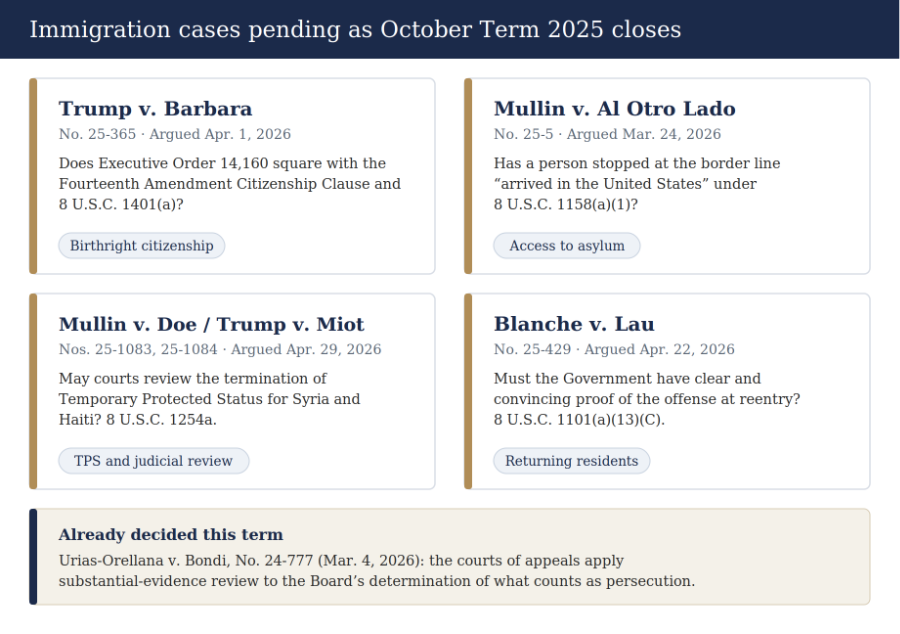
As the Supreme Court works through the final weeks of October Term 2025, a cluster of immigration cases remains undecided, and rulings are expected before the Court rises for its summer recess. Taken together, the pending cases reach further into the architecture of immigration law than any single term has in years. They ask who is a citizen at birth, when a person fleeing harm has arrived in the United States for purposes of seeking asylum, whether the courts may review the termination of Temporary Protected Status, and how the Government must prove its case against a lawful permanent resident returning from a trip abroad. None of these questions is academic. Each will shape the day to day work of removal defense and the advice we give clients who are living with uncertainty right now.
The term has already produced one consequential immigration decision. In Urias-Orellana v. Bondi, No. 24-777, 607 U.S. _ (2026) (decided Mar. 4, 2026), a unanimous Court, in an opinion by Justice Jackson, held that the courts of appeals must apply substantial-evidence review to the Board of Immigration Appeals’ determination whether a given set of undisputed facts amounts to persecution. The practical effect is to insulate agency persecution findings from searching appellate second-guessing, and it sets the tone for a docket on which the executive branch has fared well. The cases described below are the ones still awaiting answers.
A housekeeping note for practitioners tracking these matters. Two changes in administration personnel have changed the case names. Markwayne Mullin succeeded Kristi Noem as Secretary of Homeland Security, and Todd Blanche succeeded Pam Bondi as Attorney General.1 Under the ordinary rule of automatic substitution for public officers sued in their official capacity, see Sup. Ct. R. 35.3; Fed. R. App. P. 43(c)(2), several captions now read differently from the petitions and from much of the early commentary. The discussion below uses the current captions and flags the former names where it helps.
Birthright Citizenship: Trump v. Barbara
The first dispute over a second-term policy to reach the Court for a merits decision is the challenge to Executive Order 14,160, which directs federal agencies not to recognize citizenship for children born in the United States beginning 30 days after the order, when neither parent is a citizen or lawful permanent resident and the mother was either unlawfully present or present only on a temporary basis. See Exec. Order No. 14,160, 90 Fed. Reg. 8449 (Jan. 29, 2025). The order has never taken effect; every court to consider it has blocked it. The United States District Court for the District of New Hampshire entered a preliminary injunction and provisionally certified a nationwide class, and the Court granted certiorari before judgment from the First Circuit.
The question presented is whether the order complies with the Citizenship Clause, U.S. Const. amend. XIV, § 1, and with its statutory codification at 8 U.S.C. § 1401(a). The Government’s position rests on the clause’s words subject to the jurisdiction thereof, which it reads to require complete political allegiance rather than mere presence within the reach of United States law, drawing on Elk v. Wilkins, 112 U.S. 94 (1884). The challengers rely on the settled reading of United States v. Wong Kim Ark, 169 U.S. 649 (1898), under which a child born on United States soil to alien parents is a citizen regardless of the parents’ immigration status. At the April 1, 2026 argument a majority of the Court appeared unpersuaded by the Government’s theory, and several Justices pressed the Solicitor General on how the order would operate in practice.2
For our clients the stakes are immediate and generational. A ruling for the Government would, for the first time, make a child’s citizenship turn on the parents’ status at the moment of birth, with cascading effects for documentation, benefits, and derivative immigration relief. A ruling against the Government would settle the question on terms the practicing bar has long assumed to be beyond serious dispute.
Access to the Asylum Process at the Border: Mullin v. Al Otro Lado
This case, formerly captioned Noem v. Al Otro Lado, tests the lawfulness of the practice known as metering or turnback, under which Customs and Border Protection officers stationed at or just short of a port of entry directed asylum seekers to wait on the Mexican side rather than be inspected and processed. The statute permits any noncitizen who is physically present in the United States or who arrives in the United States to apply for asylum. 8 U.S.C. § 1158(a)(1). The United States District Court for the Southern District of California held the practice unlawful, and the Ninth Circuit affirmed.
The question presented is whether a person stopped on the Mexican side of the line has arrived in the United States within the meaning of Section 1158(a)(1). The Government invokes the presumption against extraterritoriality, arguing that the asylum provisions do not reach a person who has not physically crossed onto United States soil, so that an officer who blocks the final step can postpone the statutory right to ask for protection. The respondents answer that a person who presents at a port of entry has arrived in the ordinary and statutory sense, and that the Government cannot read the right out of the statute through the placement of officers. At the March 24, 2026 argument several Justices appeared receptive to the Government’s framing.3
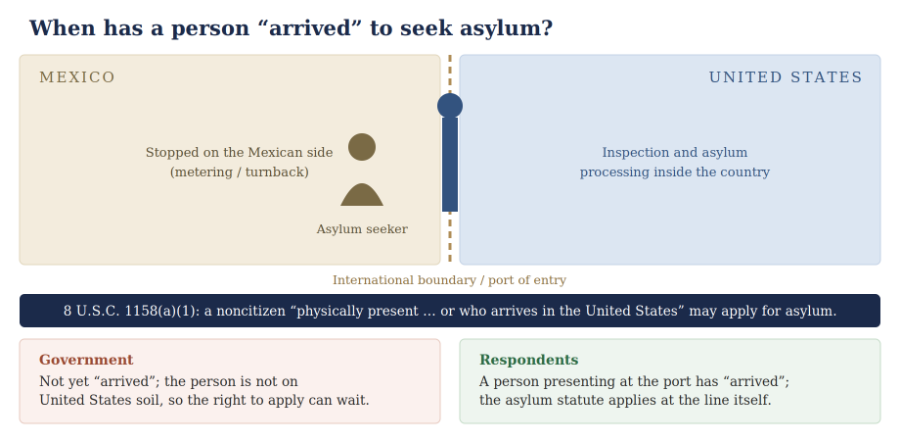
The decision will matter well beyond the specific memorandum at issue. If the Court accepts that control of the physical line lets the executive defer the moment of arrival, the holding will supply a template for future efforts to build pre-screening barriers outside the ordinary statutory process. If the Court rejects that view, it will reaffirm that the asylum statute operates at the border itself rather than at a location chosen for enforcement convenience.
Temporary Protected Status and Judicial Review: Mullin v. Doe and Trump v. Miot
The Court has taken up, on an expedited basis and consolidated for argument, two challenges to the termination of Temporary Protected Status. Mullin v. Doe, No. 25-1083, concerns Syrian nationals, and Trump v. Miot, No. 25-1084, concerns Haitian nationals. Both arise under the TPS statute, 8 U.S.C. § 1254a, which lets the Secretary designate a country whose conditions make safe return impossible and which shields nationals of that country from removal while the designation lasts.
The central issue is reviewability. The statute provides that there is no judicial review of the Secretary’s determination with respect to the designation, termination, or extension of a designation. 8 U.S.C. § 1254a(b)(5)(A). The Government reads that bar broadly, contending that its decisions to end protection are committed to its discretion and lie beyond the reach of the courts. The TPS holders respond that the bar does not immunize terminations that fail to follow the statute’s own commands, and that accepting the Government’s theory would place decisions affecting more than a million people, across every designated country, outside any judicial check.4
Because the Government has moved to terminate every designation that has come up for review, this is the first occasion on which the Court will address head on whether and how those terminations can be tested in court. A decision endorsing unreviewability would remove a meaningful avenue of relief for a large and settled population; a decision allowing review would keep the statute’s conditions enforceable. The argument took place on April 29, 2026.
Returning Residents, Parole, and the Burden of Proof: Blanche v. Lau
This case, formerly captioned Bondi v. Lau, involves a lawful permanent resident who returned from a trip abroad while facing only an unproven criminal charge, was paroled into the country by the Department of Homeland Security, and was later charged as inadmissible once the charge resolved. As a rule, a returning resident is not regarded as seeking admission, and therefore is not subject to the grounds of inadmissibility, unless one of six statutory exceptions applies, including having committed an offense identified in the criminal inadmissibility provisions. See 8 U.S.C. §§ 1101(a)(13)(C)(v), 1182(a)(2)(A)(i)(I). The Second Circuit ruled for the resident, vacated the removal order, and remanded.
The question presented is whether, to treat such a resident as seeking admission and remove him on that basis, the Government must have possessed clear and convincing evidence of the disqualifying offense at the time of his last reentry, rather than relying on a later conviction to supply that proof after the fact. The Government argues that it need only show the offense by clear and convincing evidence at the removal hearing, and that the parole decision itself is unreviewable. The resident argues that an unproven charge is not clear and convincing evidence of a committed offense, so that the predicate for treating him as an arriving applicant did not exist when he returned. The case was argued on April 22, 2026.
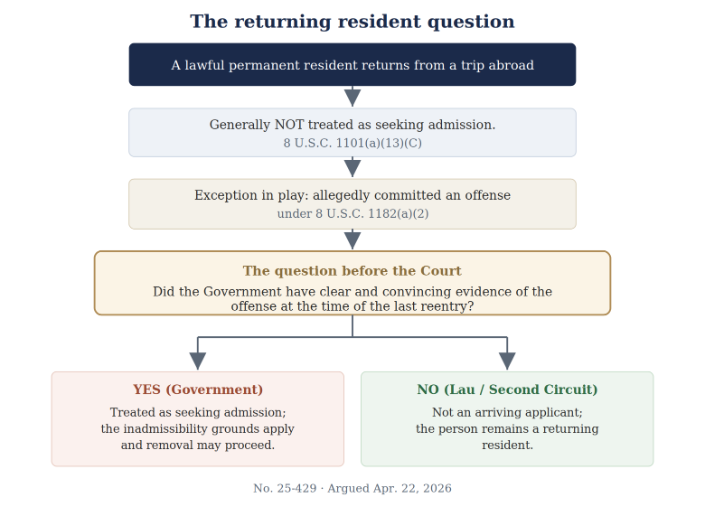
For the many lawful permanent residents who travel with old or pending charges in the background, the outcome will determine whether a return trip can be converted into an admission contest months or years later. It is a narrow question of timing and proof with broad consequences for how returning residents are screened.
Practical Implications
Several of these decisions could issue on any opinion day before the recess, and practitioners should be ready to act quickly. A few points of immediate relevance:
- First, track the cases under their current captions. The substitutions of Mullin for Noem and Blanche for Bondi mean that docket searches and alerts keyed to the old names may miss the decisions when they land.
- Second, for clients with citizenship concerns, Trump v. Barbara will control. Until the Court rules, Executive Order 14,160 remains enjoined and has never taken effect, and children born here continue to be citizens under existing law; advice should rest on that footing while preserving any documentation that establishes a child’s place of birth.
- Third, for clients turned away at or near a port of entry, Mullin v. Al Otro Lado may reshape what counts as arrival. Preserve the facts of each attempted presentation, including dates, locations, and the names of officers, because the value of those records will depend on how the Court defines the statutory term.
- Fourth, TPS holders from Syria, Haiti, and the other designated countries should be counseled candidly about both outcomes in Mullin v. Doe and Trump v. Miot, and about parallel forms of relief that do not depend on the designation, so that a termination upheld as unreviewable does not leave a client without a plan.
- Fifth, lawful permanent residents who travel with unresolved or past charges should understand the risk that a return trip can trigger an admission contest. Pending Blanche v. Lau, the cautious course is to resolve charges before international travel where possible and to document status carefully at reentry.
Finally, read these cases together with Urias-Orellana. The term’s through line is judicial deference to the executive in immigration administration. Whether that line holds in the citizenship case, where the Court signaled skepticism, or extends into asylum access, status terminations, and the treatment of returning residents, will define the landscape in which we litigate for some time to come. We will follow each decision as it is announced and report on its consequences for practice.
- Senate confirms Markwayne Mullin to be DHS secretary, replacing Kristi Noem, NBC News (Mar. 24, 2026); Trump fires Pam Bondi as US attorney general, elevates Todd Blanche, Al Jazeera (Apr. 2, 2026).
- Amy Howe, Supreme Court appears likely to side against Trump on birthright citizenship, SCOTUSblog (Apr. 1, 2026); Cong. Rsch. Serv., LSB11423, Trump v. Barbara: Supreme Court Considers Birthright Citizenship (2026).
- Justices seem inclined to revive Trump policy blocking migrants at border, Washington Post (Mar. 24, 2026).
- Legal Teams React to SCOTUS Arguments on Cases Challenging Termination of TPS for Haiti and Syria, UCLA Law (Apr. 29, 2026) (noting the terminations of thirteen designations and the Government’s position that TPS decisions are unreviewable).