
- Introduction
- The Statutory Framework
- The Metering Policy and the Litigation Below
- The Supreme Court’s Decision
- The Dissents
- Practical Implications for Practitioners
Introduction
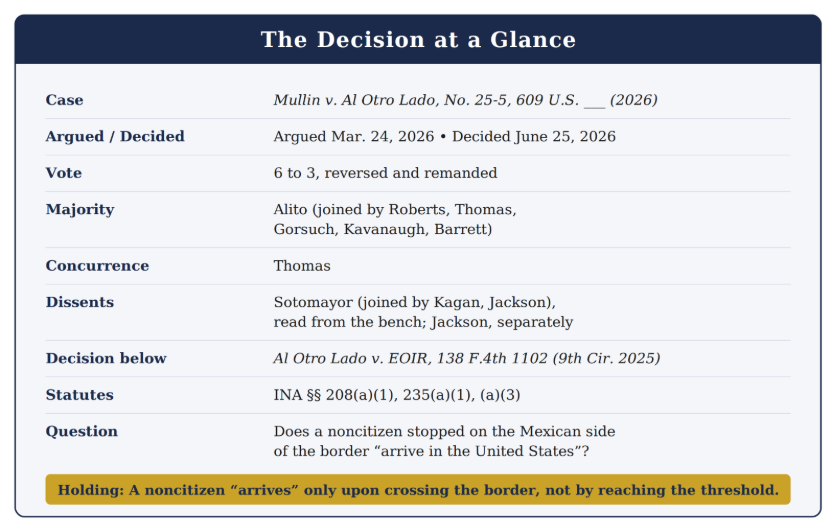
On June 25, 2026, the Supreme Court of the United States, by a vote of six to three, reversed and remanded a decision of the United States Court of Appeals for the Ninth Circuit and held that a noncitizen who stands on the Mexican side of the United States-Mexico border, and who is physically prevented from setting foot on United States soil, has not “arrived in the United States” within the meaning of the Immigration and Nationality Act (INA). Mullin v. Al Otro Lado, No. 25-5, 609 U.S. _ (2026). Writing for the majority, Justice Alito held that such a person is neither entitled to inspection under INA § 235(a)(3) nor eligible to apply for asylum under INA § 208(a)(1), because a noncitizen “arrives in the United States” only upon crossing the border into this country. The decision resolves a question of considerable practical importance for asylum seekers who present themselves at land ports of entry along the southern border, and it confirms the lawfulness of the border-management practice known as “metering.”1
This article reviews the statutory framework, the litigation history, the Court’s reasoning, the dissents, and the implications of the decision for removal-defense practitioners and their clients. The snapshot below summarizes the disposition.
The Statutory Framework
Two provisions of the INA, both enacted in substantially their current form by the Illegal Immigration Reform and Immigrant Responsibility Act of 1996 (IIRIRA), Pub. L. No. 104-208, 110 Stat. 3009-546, frame the dispute. The first, INA § 235(a)(1), 8 U.S.C. § 1225(a)(1), provides that an alien “present in the United States who has not been admitted or who arrives in the United States” is “deemed … an applicant for admission,” and INA § 235(a)(3) requires that all applicants for admission “shall be inspected by immigration officers.” The second, INA § 208(a)(1), 8 U.S.C. § 1158(a)(1), provides that “[a]ny alien who is physically present in the United States or who arrives in the United States (whether or not at a designated port of arrival) … may apply for asylum.”
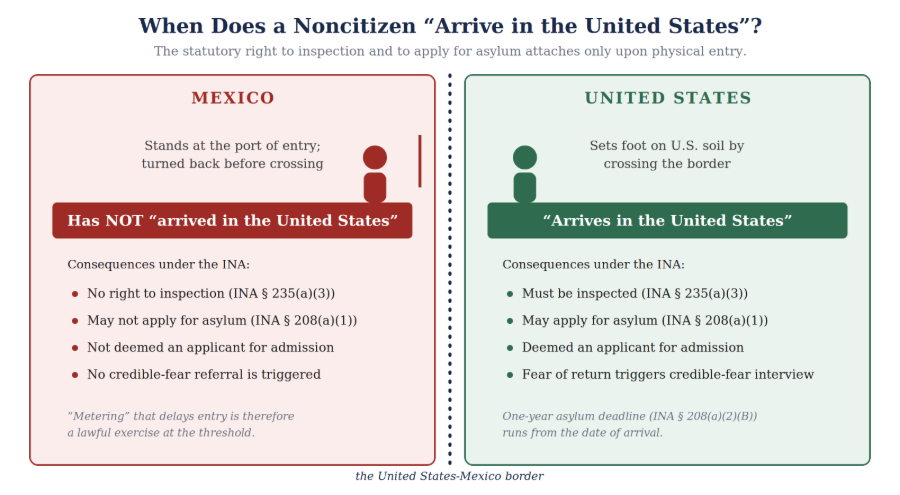
Under the statutory scheme, an alien who “arrives in the United States” is entitled to inspection, is deemed an applicant for admission, and may apply for asylum; if the alien expresses a fear of persecution during inspection, the officer must refer the alien for a credible-fear interview rather than proceed with expedited removal. INA § 235(b)(1)(A)(ii). For background on these procedures, see our discussions of expedited removal and seeking asylum in the United States. The case turned entirely on when a noncitizen seeking to enter from Mexico “arrives in the United States”: when standing in Mexico at the border, or only upon crossing it. The competing readings, and their consequences, are illustrated below.
The Metering Policy and the Litigation Below
Beginning in the spring of 2016, U.S. Customs and Border Protection (CBP) experienced surges of aliens seeking admission at southern-border ports of entry in numbers that sometimes exceeded safe processing capacity. In November 2016, the Department of Homeland Security adopted a policy of “metering” the number of arriving aliens whom CBP would inspect each day. To enforce the policy, officers stood on the United States side of the border and prevented entry by more aliens than a port could adequately process. The metering policy continued across three presidential administrations before it was rescinded in November 2021, shortly after a district court ruled it unlawful.
In 2017, the immigration-advocacy organization Al Otro Lado, together with thirteen individual asylum seekers, filed a putative class action in the United States District Court for the Southern District of California, contending that CBP’s metering practice unlawfully withheld inspection and asylum processing in violation of the INA and the Administrative Procedure Act. The district court certified a class, granted summary judgment, and declared that the denial of inspection or asylum processing to class members “in the process of arriving in the United States” was unlawful regardless of justification. A divided panel of the Ninth Circuit affirmed in relevant part, holding that an alien “arrives in the United States,” and so must be inspected and may apply for asylum, when the alien, while standing on the Mexican side of the border, encounters a United States official at the border. Al Otro Lado v. Executive Office for Immigration Review, 138 F.4th 1102 (9th Cir. 2025). Judge Nelson dissented, and twelve judges dissented when the court denied rehearing en banc, contending that the panel’s reading defied the statute’s plain text.
The Supreme Court’s Decision
Justice Alito, joined by Chief Justice Roberts and Justices Thomas, Gorsuch, Kavanaugh, and Barrett, framed the question as “straightforward” and answered that a noncitizen standing in Mexico does not “arriv[e] in the United States” by attempting, and failing, to set foot in this country. The Court first held that the case was not moot, because the district court’s class-wide declaratory relief continued to bar metering within the Ninth Circuit and the Government represented that it would resume metering if border conditions warranted. Chafin v. Chafin, 568 U.S. 165 (2013).
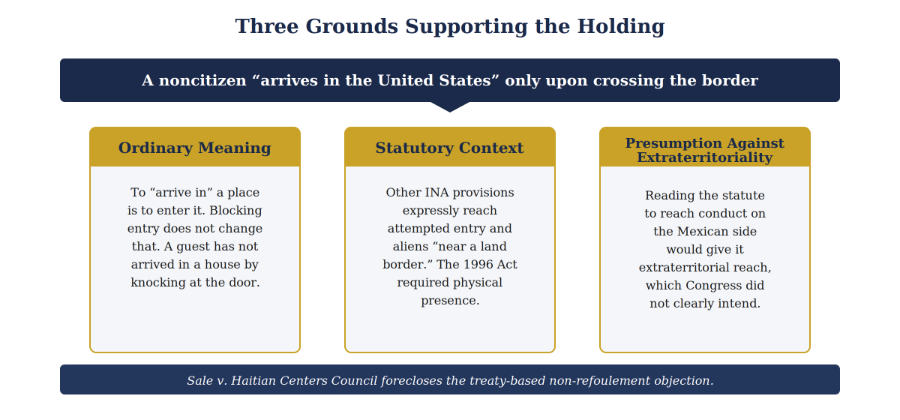
On the merits, the Court rested on three principal grounds, summarized in the figure that follows. First, it held that the phrase “arrives in the United States” carries its ordinary meaning: a person arrives in a place only when he enters it, and that conclusion does not change because someone or something blocks his entry. The Court illustrated the point with everyday examples, observing that a running back does not arrive in the end zone when he is tackled at the one-yard line, and a guest does not arrive in a house when the homeowner locks the door before he can open it. Second, the Court found that statutory context confirmed the ordinary-meaning reading. Other provisions of the INA expressly refer to attempted entry, see, e.g., INA §§ 275(a)(1), 276(a)(2)(B), 287(a)(2), and to aliens arriving “near a land border,” INA § 103(a)(10), yet §§ 208(a)(1) and 235(a)(1) contain no such language; and IIRIRA’s 1996 amendment replacing “at a land border or port of entry” with “arrives in the United States” signaled that physical presence is now required. Third, the Court held that the presumption against extraterritoriality, see Morrison v. National Australia Bank Ltd., 561 U.S. 247 (2010), would independently tip the scale against the respondents’ reading, because their interpretation would give the inspection and asylum provisions extraterritorial reach over conduct on the Mexican side of the border.
The Court acknowledged that its reading rendered the “arrives in” language partially redundant of the “physically present” language in § 208(a)(1), but it concluded that the anti-surplusage canon was not an “iron rule” and that the partial redundancy was understandable, as the “arrives in” phrase was added in 1996 to correspond with the new expedited-removal process triggered by arrival. Finally, the Court rejected the argument that its interpretation violated the Nation’s non-refoulement obligations under Article 33 of the 1951 Convention Relating to the Status of Refugees, July 28, 1951, 189 U.N.T.S. 150, as implemented through the 1967 Protocol, Jan. 31, 1967, 19 U.S.T. 6223, T.I.A.S. No. 6577, holding that Sale v. Haitian Centers Council, Inc., 509 U.S. 155 (1993), foreclosed the argument because Article 33 says nothing about a nation’s conduct toward aliens outside its territory. The Court also deemed “overstated” the contention that its reading would create perverse incentives for illegal entry, noting that metering merely delays entry, whereas unlawful entry carries criminal liability under INA § 275(a) and renders an alien ineligible for asylum and certain benefits.
The Dissents
Justice Sotomayor, joined by Justices Kagan and Jackson, dissented and read her dissent from the bench, a step the Justices reserve for cases of strong disagreement. She emphasized that since 1917 Congress has required immigration officers to inspect noncitizens who arrive at ports of entry, and that the majority’s reading allows the Government to circumvent that mandatory framework simply by stationing officers at the border to physically block noncitizens from setting foot on United States soil. She also observed that metering, in her view, had come to have little to do with genuine capacity constraints, citing a whistleblower account, and that the practice contributed to dire humanitarian conditions for migrants waiting in Mexico. The dissent further addressed the limits that INA § 242(f)(1), 8 U.S.C. § 1252(f)(1), places on class-wide injunctive relief.
Justice Jackson filed a separate dissent arguing that the Court should not have reached the merits at all. In her view, because metering is no longer in effect and the Government had no concrete plans to reinstate it, the majority engaged in an unwarranted “rush to greenlight” a retired practice.2 The case also produced an unusual moment at the bench. After Justice Sotomayor finished reading her dissent, in which she warned that the majority’s reading “regrettably and tragically extinguishes the light of the torch of the Statue of Liberty,”3 Justice Alito offered an impromptu response, defending the metering policy as “orderly and humane” and noting that two presidential administrations had employed it.4
Practical Implications for Practitioners
At the systemic level, Mullin confirms that the statutory rights to inspection and to apply for asylum attach only upon physical entry into the United States, and that the Government may lawfully use metering and similar threshold controls to manage the flow of arriving aliens at ports of entry. The decision sits alongside other recent measures that operate at or before the border, including the Migrant Protection Protocols and the various transit and proclamation-based asylum limitations now in litigation. See, e.g., our analysis of the D.C. Circuit’s decision in RAICES v. Noem addressing the Inauguration Day asylum proclamation. Although the metering policy at issue was rescinded years ago, the Court’s reasoning supplies a durable interpretive rule that the Government may invoke to defend future threshold practices at the southern border.
At the level of the individual client, the decision counsels caution. A noncitizen who presents at a land port of entry and is turned back while still in Mexico acquires no statutory entitlement to inspection or to file an asylum application; the trigger is physical presence in, or crossing into, the United States. Practitioners should advise clients accordingly and should document each encounter at a port of entry, including dates, locations, and the identity of officers, in the event that conditions or policy change. Counsel should also caution clients that responding to a turn-back by attempting unlawful entry between ports of entry carries serious adverse consequences, including criminal exposure under INA § 275(a) and potential ineligibility for asylum and certain benefits. For clients who do reach United States soil and express a fear of return, the credible-fear and asylum frameworks remain available, and the one-year filing deadline of INA § 208(a)(2)(B) continues to run from the date of arrival. Noncitizens already physically present in the United States are unaffected by the decision as to the physical-presence prong of § 208(a)(1). Any noncitizen facing these circumstances should consult an experienced immigration attorney without delay.
- Jordan Rubin, Supreme Court Sides 6-3 With Trump Administration on Immigration Asylum Border Policy, MS NOW, Deadline: Legal Blog (June 25, 2026).
- Supreme Court Rules Asylum Seekers May Be Turned Around, Siding With Trump, The Hill (June 25, 2026).
- Supreme Court Clears Way for Trump Administration to Revive Restrictive Immigration Policy, The Philadelphia Inquirer (June 25, 2026).
- Live Updates: Supreme Court Opinions on Asylum Policy, Temporary Protected Status, CNN (June 25, 2026).